Showing posts with label historic photographs. Show all posts

Monday, February 3, 2025

Soldiers of the 54th and 55th Regiments on Display

The five portraits ready for exhibit,
individual images are included below
In honor of Black History Month, we are displaying a selection of carte de visites and tintypes that depict soldiers from the Massachusetts 54th and 55th Volunteer Infantry Regiments in our Collection Spotlight case. As part of the Alfred S. Hartwell Collection, these images serve as important documentation of Black Civil War soldiers. The 54th and 55th Regiments are significant because they were the first two regiments comprised of Black soldiers from the North to serve in the Civil War. A monument commemorating the soldiers of the 54th is located on Beacon Street at the edge of Boston Common, directly across from the State House.

A quick explanation of what these items are, since early photographic formats are not necessarily in use today. Carte de visites are small photographs, similar in size to a formal calling card, that were introduced in the United States in 1859 and rose in popularity during the Civil War. They were traded among friends and sometimes collected in albums. As per their name, tintypes were photographs made on tin that was coated with a dark lacquer or enamel to support the emulsion. They were used for portraiture and were prevalent in the United Stats from the 1860s to the 1870s. They were affordable to produce, which added to their popularity. In total, there are forty-four carte de visites and tintypes in the Hartwell collection, but these five are the only ones that depict Black soldiers.

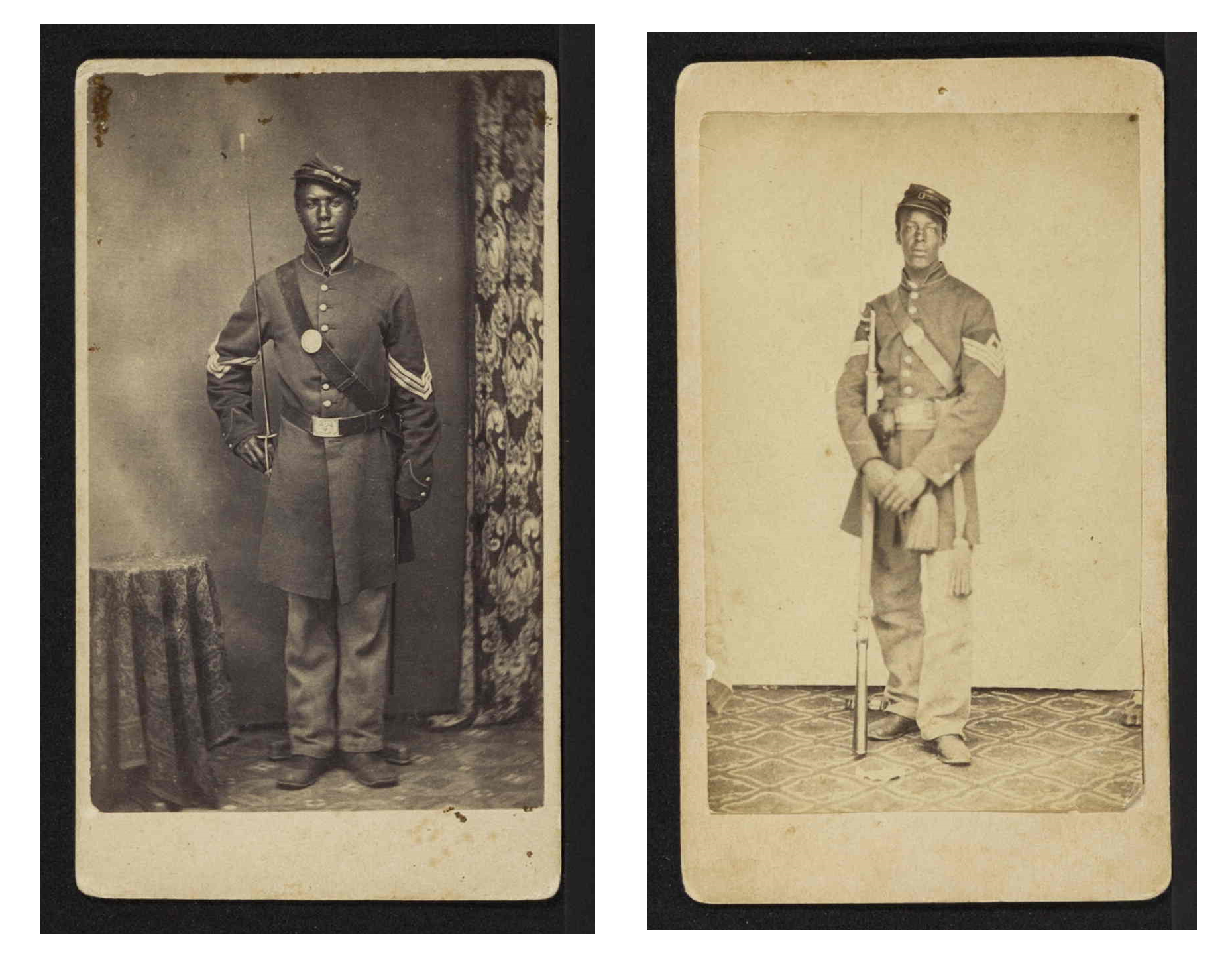
Three of the five images include some identifying information on the reverse. Pictured below are two carte de visites, the inscriptions on the back identify them as Sergeant Andrew Jackson Smith on the left and Segt. Jackson / 55 Regiment on the right.

An image of “Joe” provides the most information in the inscription. He is identified as “Joe / Headquarters / Camp Meigs / Readville, Mass. / Oct 1862.” Camp Meigs was a training camp used from 1862 through 1865. It is in the Readville neighborhood (part of Hyde Park) of Boston, and the 54th and 55th regiments both trained there.


 The following two images are tintypes and include no identifying information:


On January 26, 1863, Massachusetts governor John Andrew received permission from the U.S. War Department to raise a Black regiment as part of the Union Army. Enlistment began in February, and those who joined became the 54th Massachusetts Volunteer Infantry Regiment. There was not a large enough Black population in Massachusetts to support a full regiment, so recruitment efforts were focused not just in Massachusetts and New England, but also throughout the country and even into Canada and the West Indies. The result was that there were so many volunteers that the 55th Regiment was also formed. The regiments both trained outside of Boston at Camp Meigs (as referenced in the “Joe” inscription) and the 54th departed for the south in late May 1863, with the 55th departing in July 1863. The National Park Service has articles with information about both the 54th and the 55th regiments on their website. 

During the Civil War, Alfred S. Hartwell, who compiled this collection, served as Captain of the 54th Regiment and then as Lieutenant Colonel of the 55th Regiment. Because of his experience with Black regiments, after the war, he spearheaded an investigation into abuses in the recruiting of Black soldiers in the south. The images displayed here are mementos from Hartwell’s time serving with members of the 54th and 55th Regiments, but the collection also includes materials that document his investigation. The collection has been fully digitized and is available in our digital repository. You can also read more about Hartwell in this previous blog post.

Our Collection Spotlight case has features that mitigate the amount of light that exhibited items are exposed to, but due to the sensitive nature of photographs, we are still mindful of the frequency with which they are displayed. Visit us from February 4 through March 4 to take advantage of the rare opportunity to see these images in person.


Elizabeth Roscio
Preservation Librarian
 

Monday, April 29, 2024

Preservation Week at the State Library!

Happy Preservation Week! Established by the American Library Association in 2005, Preservation Week is a yearly event that raises awareness for preservation work undertaken in library, archives, and museums to safeguard our shared cultural heritage. Preservation Week is also a time to encourage the public to think about actions that they can take to protect their own personal collections. This year, it is celebrated from April 28 through May 4 with the theme "Preserving Identities." 

In our Collection Spotlight case, we’re kicking off Preservation Week by highlighting an item that has benefited from preservation work and also aligns with May’s designation as Asian American and Pacific Islander (AAPI) month. Last year, we shared a few facsimiles from an album titled “Photographs of Schools,” which was produced by the Hawaii Department of Education and donated to the State Library in July 1924. It comprises seventeen photographs of Hawaiian schools, teachers, and students dating from sometime between 1897 and 1922. This year, we’re sharing the album itself in our Collection Spotlight case. The reason that we can share the actual item instead of facsimiles is because our Collection Spotlight case is specifically designed to protect exhibited items. One of the largest threats to archival items is light damage, from both natural and artificial light sources, which accumulates over time and cannot be reversed. As such, it is optimal for archival items to remain in dark storage unless they are being accessed by a researcher - but this at odds with the desire to display archival items! Luckily, our Collection Spotlight case has been designed with this in mind, and its glass panel is “SmartGlass” which has UV filters and a layer of light-controlling film. When not in use, the glass portion of the case is dark, until it is activated by a button which lights the case for 30 seconds. This allows the case to remain dark for the majority of the time but illuminated when a visitor wants to view the exhibited item, allowing us to safely display even our more sensitive items, like the photograph album we’re sharing this month. Regular readers of our blog may have noticed that the contents of our Collection Spotlight case changes every month. This is another preventative preservation measure, as a monthly exhibit rotation limits the amount of time that an archival item spends out its controlled storage environment. 


Another way that this scrapbook has benefited from preservation initiatives is that it has been digitized. The most obvious benefit of digitization is that it makes our collection more accessible to a wider audience who can access it remotely, but from a preservation standpoint, it is also beneficial because it reduces the amount of handling that the item receives. The more an item is handled, the higher the likelihood is that it will be damaged. By having researchers access a digital surrogate, we can preserve the integrity of the original and ensure its longevity. We do some digitization on-site, but we also send larger projects to vendors off-site. 

This month, we’ve displayed the album open to a show an image of pupils in front of the Kawaiaha’o Common School (above) and an image of a few of the teachers grouped with a few students (right). The Common School was originally the Old Mission School House, founded in the 1830s by missionary Sybil Bingham.  Unfortunately, only two of the images can be exhibited, but the album in  its entirety can be viewed here. And another preservation note, if we were to exhibit this album again, we would select different pages to open it to. 

Stop by the library throughout the month of May to see this scrapbook on display, and follow along as we share preservation content on our social media channels all week! You can also check out our two preservation focused Flickr pages for examples of work done in our lab and preservation tips you can use at home.


Elizabeth Roscio
Preservation Librarian

Monday, March 22, 2021

Old Photographs of Boston

During a major cataloging project at the State Library, the staff rediscovered many of our beautiful collections, including maps, photographs, and manuscripts. These collections are now fully cataloged and can be found in our online catalog.

One of my favorites is the “Photographs of Old Boston” collection, which we were able to digitize and can be found in the Library’s digital repository, DSpace or through the Library’s Flickr page.

Public Garden, 1857
This album was acquired by the State Library from G.H. Marsh in 1907 and consists of 49 black and white photographs that provide views of Boston during the 19th century. It shows historic buildings, storefronts, cathedrals, and well-known Boston sites like the Garden and the Old State House, as well as places that no longer exist like the John Hancock house. What is interesting about these photographs is how certain places have changed but also how they have remained the same.
John Hancock House,
1860

 You can access the full collection from either   DSpace or the Library’s Flickr page.


 Silvia Mejia
 Special Collections Librarian
 State Library of Massachusetts