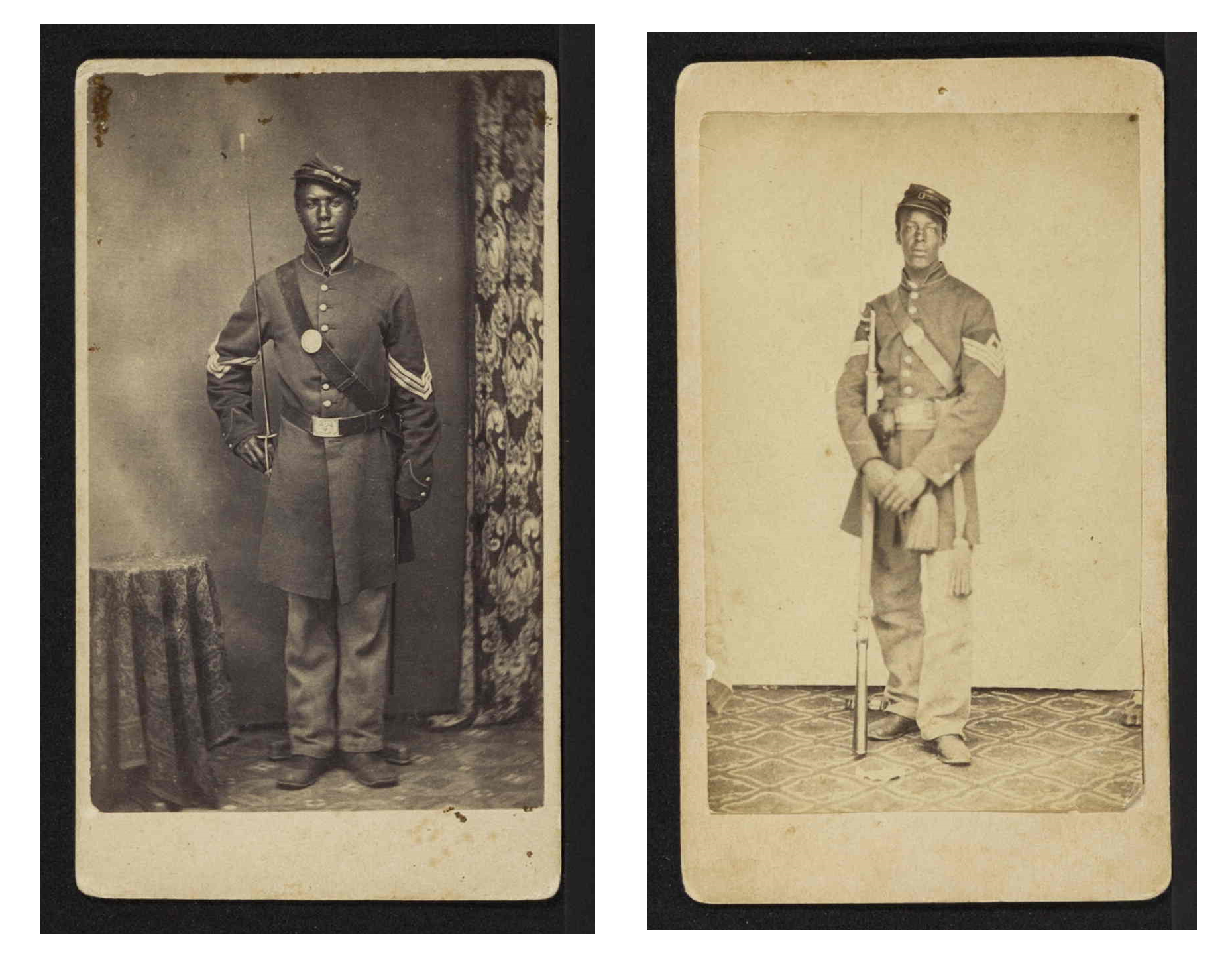
Carney and Plunkett are linked together in my mind, though I do not know whether the two ever met. There are several reasons for this. Both men served the Union as flag bearers for their respective Massachusetts regiments; both were awarded the Medal of Honor for their actions during battle; and both of them once worked in the State House, which I learned through the battle flag photograph collection and stories Silvia, our Head of Special Collections, told me. This building holds so many stories, many which risk being lost to time if we do not make a point to pass them on. This is especially true for the stories of people who are not memorialized in portraits, murals, and plaques throughout the State House halls.
Thankfully, Thomas Plunkett and William H. Carney are represented in Memorial Hall. I wanted to expand on their stories in this post in honor of Juneteenth. Many thanks to Boston African American National Historic Site’s comprehensive article about William Harvey Carney and The Armless Hero of Fredericksburg by Mark Savolis and Ronald S. Coddington, which I relied on heavily here.


From the description under the 21st Regimental battle flag facsimile in Memorial Hall:
The position of color bearer was undoubtedly one of the proudest as well as most dangerous a soldier could hold. The flags, always posted at the front, served as a beacon for one’s fellow soldiers and the enemy alike. To “preserve the Union”- to never let it fall to the ground- was the gravest of responsibilities... one for which many color bearers gave up their lives.
William Harvey Carney
 |
| Sergeant William Harvey Carney in uniform, holding the flag he bore for the 54th Massachusetts Infantry Regiment. Courtesy of the Smithsonian National Museum of African American History and Culture. |
William H. Carney was born to William Carney Sr. and Ann Dean in Norfolk, Virginia on February 29, 1840. Carney was born into slavery, and at 14 years old began secretly attending a private school led by a minister, where he learned to read and write. It is not known for sure exactly how Carney escaped enslavement. He might have escaped on his own through the Underground Railroad and joined his father in Massachusetts; it is also possible his father purchased his freedom after reaching Massachusetts himself. Carney's family ultimately settled in New Bedford, where William considered going into ministry.
But in 1863, the Union army finally allowed Black Americans to serve in combat roles. Carney's life changed course: "I had a strong inclination to prepare myself for the ministry; but when the country called for all persons, I could best serve my God by serving my country and my oppressed brothers. The sequel is short – I enlisted for the war,” Carney wrote in October 1863. Carney joined the Morgan Guards in February of 1863, at 23 years old. This Black militia, originally named for a white benefactor from New Bedford, changed its name to the "Toussaint Guards" in honor of Haitian Revolutionary leader Toussaint Louverture. The Toussaint Guards joined with the 54th Massachusetts Regiment, where Carney served in Company C. He was promoted to sergeant in March 1863.
On July 18, 1863, the 54th Massachusetts led the charge on Fort Wagner outside of Charleston, South Carolina under the command of Colonel Robert Gould Shaw. When their flag bearer was shot down, Sergeant Carney retrieved the flag and continued to march, though he was seriously wounded himself. When the Union was forced to retreat, Carney continued carrying the flag until he could hand it to another soldier of the 54th behind Union lines. Carney famously exclaimed, "Boys, I did but my duty; the dear old flag never touched the ground!"
 |
| Sergeant Carney's story inspired many pieces of art and music, like the song pictured here. |
Carney was honorably discharged in June 1864 due to his injuries. He spent some time in San Francisco following the war, but then returned to New Bedford, working for 32 years as the state’s fourth African American postman. He married Susannah Williams on October 11, 1865 in New Bedford and had one daughter, Clara Heronia. For the rest of his life, Carney was an active participant in Black veterans’ organizations. He attended reunions and battle anniversary memorials as a member of the Grand Army of the Republic Post 1 and was the featured singer of the Star-Spangled Banner at a ceremony in 1889.
On May 31, 1897, Carney joined his fellow surviving members of the 54th for the dedication ceremony of Augustus Saint-Gaudens’ The Robert Gould Shaw/54th Massachusetts Regiment Memorial, in the Boston Common directly across from the State House. Sergeant Carney finally received the Medal of Honor for his actions at the Battle of Fort Wagner in May 1900, when he was 60 years old. He was the first of 22 African American Civil War veterans who ultimately received the Medal of Honor.
After leaving the postal service in New Bedford, Carney came to work as a messenger at the State House. Then in November 1908, he was tragically, fatally injured in an elevator accident at the State House. Printed accounts of the event state that Carney was trying to back out of the elevator to make room for others when the doors closed, catching his injured leg. He died at Boston City Hospital on December 9, 1908. He was 68 years old. Carney was buried at Oak Grove Cemetery in New Bedford. And on the afternoon of December 11, 1908, the flags at the Massachusetts State House flew at half-staff in honor and remembrance of Sergeant William Harvey Carney’s valiant life.
Thomas Plunkett
 |
| Sergeant Thomas Plunkett in uniform, pictured with the flag he bore for the 21st Massachusetts Infantry Regiment. Courtesy of the Library of Congress. |
Thomas Francis Plunkett was born in County Mayo, Ireland in 1839. After the death of his mother, his father Francis brought Thomas and his brothers to America and settled in Boston. By 1861, Thomas was working as a bootmaker in West Boylston and was engaged to be married. He enlisted in Company E of the 21st Massachusetts Infantry Regiment. In September, the regiment became part of Major General Ambrose Burnside’s Coast Division. In early 1862, Plunkett’s regiment participated in successful operations along the North Carolina coast. By that summer, his actions in battle gained him a reputation for bravery, and he was promoted to sergeant. In September 1862, during the Battle of South Mountain, Plunkett stopped to assist a wounded, thirsty officer from Ohio. That officer turned out to be future President Rutherford B. Hayes, who recognized, embraced, and thanked Thomas years later during a presidential tour of New England.
At Fredericksburg in December 1862, the 21st Regiment fought an uphill battle. Plunkett marched on with the regimental flag as bullets tore through, shooting a hole in his cap. A shell fragment tore through his right arm, then shattered his left forearm. As he bled profusely from what was left of his arms, he planted a foot against the flagpole, still standing. His blood left a large, permanent stain on the flag. Plunkett was then sent to the rear by his colonel. He walked until faint from blood loss, and stretcher bearers carried him into Fredericksburg. Surgeons felt his case was hopeless; they left him on the floor in excruciating pain as they performed surgeries on tables just above him. Two hours later, he was finally given chloroform and surgeons cut away the mangled skin of his arms. Thomas’s life was saved by Clara Barton, who sutured and dressed his arm stumps.
 |
A news clipping dated October 21, 1885 pasted on the inside of our battle flags’ photo album cover about Plunkett and the 21st Regimental battle flag. |
He was honorably discharged on March 9, 1864, and he returned home to Massachusetts to $7,000 in charitable funds raised for him. He also received a pension as a result of Clara Barton’s letter writing assistance. Thomas bought a home in Worcester with the funds, where he married Helen Lorimer and raised three children. In March 1866, Sergeant Plunkett received the Medal of Honor. He was invited to all Civil War-related events in Worcester for the rest of his life. And like William H. Carney, he became a messenger in the State House, a position he held for 15 years. Thomas Plunkett died of inflammatory bowel and stomach disease in 1885 at 44 years old. There was a large turnout at his funeral, and one of his pallbearers was the 21st Regiment Chaplain, George Ball. He was buried in Hope Cemetery in Worcester, and his monument displays an urn draped with a flag.
Alyssa Persson
Special Collections Processing Archivist