Showing posts with label Black History Month. Show all posts

Monday, February 2, 2026

A Trailblazing Politician: Edward W. Brooke

Cover of Brooke's Birthday Ball souvenir
This February, our Collection Spotlight case features materials related to Edward W. Brooke. Brooke (1919-2015) served as Massachusetts' Attorney General from 1963-1967, earning the distinction as the first African American elected as attorney general in any state. He then went on to serve as Massachusetts' U.S. Senator from 1967-1979, earning more "firsts" as the first African American elected to the Senate by popular vote and the first African American elected to two Senate terms.

Three items that document Brooke's career in the 1960s are on display. The first is a photograph from the library’s own institutional records. Our institutional photographs record past exhibits and events held at the State Library, and this one, dated February 1963, shows Brooke (center, holding an item) with three unidentified men at an exhibit on Black History. The commemoration was known at the time of this photograph as Negro History Week, but beginning in 1970 was celebrated in communities and educational institutions as Black History Month, before receiving an official federal designation in 1976. While we cannot determine every item that is part of the display in the photograph, there are few that are identifiable. At the top center of the display is the program from the Thirty-Eighth Annual Celebration of Negro History Week (1963) for Proud American Day, on February 14. Directly below that is Brooke’s own portrait, displayed next to the cover of Fight for Freedom: The Story of the NAACP by Langston Hughes. And just below that looks to be a publication related to the memorial to Crispus Attucks on Boston Common. The rest of the display includes other publications, books, photographs, and an official Commonwealth of Massachusetts publication (maybe a proclamation?). Having a display of this nature is something that continues in the library each February, as our reference staff selects books and resources from our collection to celebrate Black history.

 
Moving further into Brooke’s career as attorney general, we are also sharing a souvenir booklet published in conjunction with a celebration ball held for his birthday on October 26, 1965 at the Grand Ballroom of the Sheraton Boston Hotel. With the heading of "Lawyer for Five Million Citizens,” the souvenir begins with four pages of career highlights, including investigating air and water pollution, improving policy surrounding eminent domain, and establishment of the Highway Laws Study Commission. Also included are photographs of Brooke with family, friends, and constituents. Additional pages include birthday wishes and sponsorship notices from groups and individuals throughout the Commonwealth. For our in-library display, we've opened the booklet to the page  with birthday greetings from individuals in Barnstable County. Adorning the cover is an artist’s rendering of Brooke, shown in the first image above.

Rounding out the display is the 1967 edition of Public Officers of the Commonwealth, also known as Bird Books, which provide photographs and biographical information for Massachusetts’ elected officials. The displayed edition is from Brooke’s first term as a U.S. Senator, showing his home address in Newton, his Republication affiliation, biographical information, organizational membership, and his public office positions. Brooke went on to serve in the U.S. Senate until 1979, and was largely known as a progressive Republican, meaning he leaned left on social policy and civil rights, but was fiscally conservative. Brooke was a strong advocate for civil rights, and while there are many achievements from his twelve years in the Senate, among the most notable was his co-writing of the Civil Rights act of 1968.

Read about Brooke’s work to establish Martin Luther King, Jr.’s birthday as a holiday in a previous blog post, and for further reading, check out his autobiography, Bridging the Divide: My Life. This Black History Month, we are excited for the opportunity to share collection items related to one of Massachusetts’ most pioneering and influential politicians, and hope that you’ll visit the library between February 3 and March 3 to see these items on display.


Elizabeth Roscio
Preservation Librarian

Monday, February 3, 2025

Soldiers of the 54th and 55th Regiments on Display

The five portraits ready for exhibit,
individual images are included below
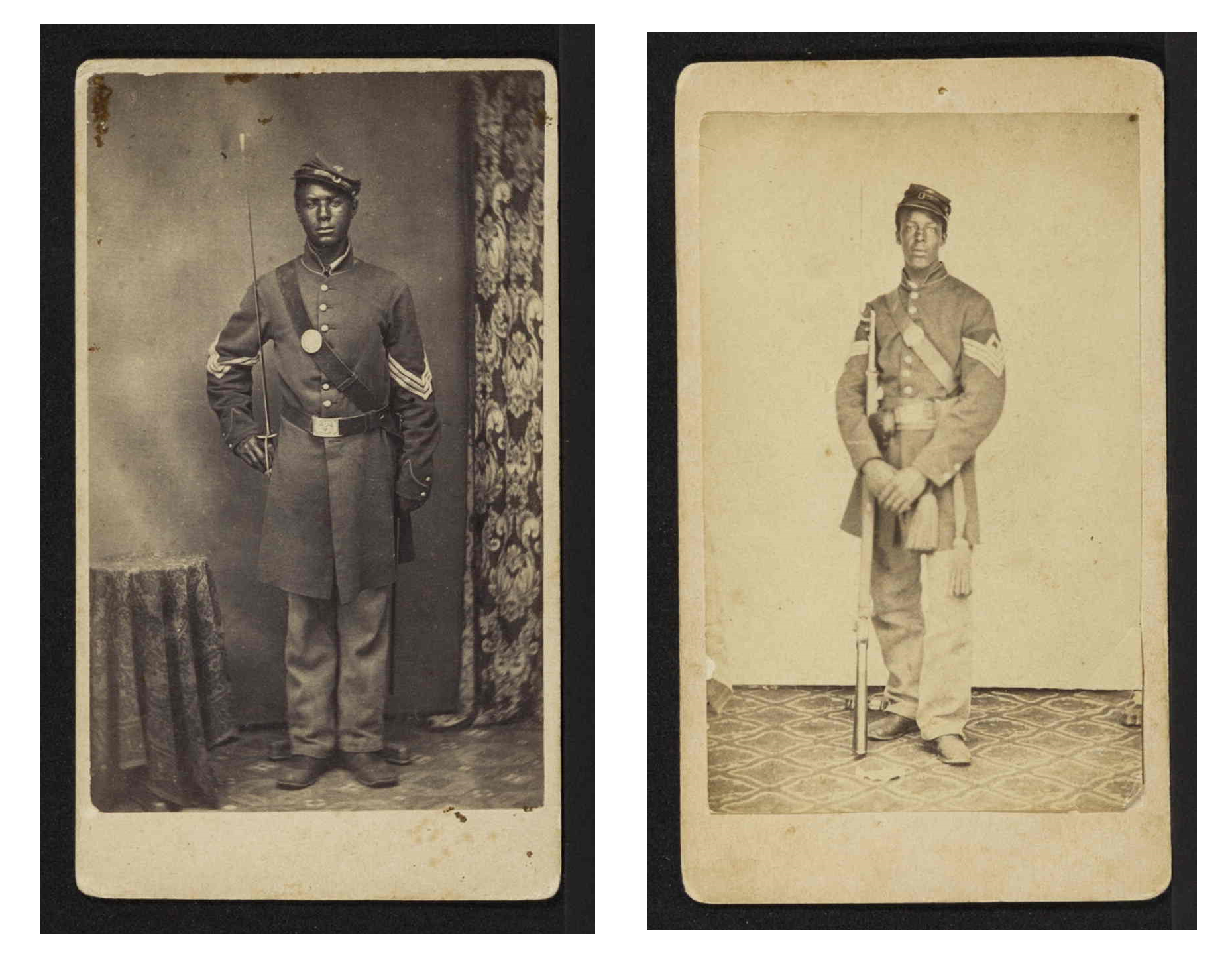
In honor of Black History Month, we are displaying a selection of carte de visites and tintypes that depict soldiers from the Massachusetts 54th and 55th Volunteer Infantry Regiments in our Collection Spotlight case. As part of the Alfred S. Hartwell Collection, these images serve as important documentation of Black Civil War soldiers. The 54th and 55th Regiments are significant because they were the first two regiments comprised of Black soldiers from the North to serve in the Civil War. A monument commemorating the soldiers of the 54th is located on Beacon Street at the edge of Boston Common, directly across from the State House.

A quick explanation of what these items are, since early photographic formats are not necessarily in use today. Carte de visites are small photographs, similar in size to a formal calling card, that were introduced in the United States in 1859 and rose in popularity during the Civil War. They were traded among friends and sometimes collected in albums. As per their name, tintypes were photographs made on tin that was coated with a dark lacquer or enamel to support the emulsion. They were used for portraiture and were prevalent in the United Stats from the 1860s to the 1870s. They were affordable to produce, which added to their popularity. In total, there are forty-four carte de visites and tintypes in the Hartwell collection, but these five are the only ones that depict Black soldiers.

Three of the five images include some identifying information on the reverse. Pictured below are two carte de visites, the inscriptions on the back identify them as Sergeant Andrew Jackson Smith on the left and Segt. Jackson / 55 Regiment on the right.


An image of “Joe” provides the most information in the inscription. He is identified as “Joe / Headquarters / Camp Meigs / Readville, Mass. / Oct 1862.” Camp Meigs was a training camp used from 1862 through 1865. It is in the Readville neighborhood (part of Hyde Park) of Boston, and the 54th and 55th regiments both trained there.


 The following two images are tintypes and include no identifying information:


On January 26, 1863, Massachusetts governor John Andrew received permission from the U.S. War Department to raise a Black regiment as part of the Union Army. Enlistment began in February, and those who joined became the 54th Massachusetts Volunteer Infantry Regiment. There was not a large enough Black population in Massachusetts to support a full regiment, so recruitment efforts were focused not just in Massachusetts and New England, but also throughout the country and even into Canada and the West Indies. The result was that there were so many volunteers that the 55th Regiment was also formed. The regiments both trained outside of Boston at Camp Meigs (as referenced in the “Joe” inscription) and the 54th departed for the south in late May 1863, with the 55th departing in July 1863. The National Park Service has articles with information about both the 54th and the 55th regiments on their website. 

During the Civil War, Alfred S. Hartwell, who compiled this collection, served as Captain of the 54th Regiment and then as Lieutenant Colonel of the 55th Regiment. Because of his experience with Black regiments, after the war, he spearheaded an investigation into abuses in the recruiting of Black soldiers in the south. The images displayed here are mementos from Hartwell’s time serving with members of the 54th and 55th Regiments, but the collection also includes materials that document his investigation. The collection has been fully digitized and is available in our digital repository. You can also read more about Hartwell in this previous blog post.

Our Collection Spotlight case has features that mitigate the amount of light that exhibited items are exposed to, but due to the sensitive nature of photographs, we are still mindful of the frequency with which they are displayed. Visit us from February 4 through March 4 to take advantage of the rare opportunity to see these images in person.


Elizabeth Roscio
Preservation Librarian
 

Monday, February 5, 2024

Bird's-Eye View of Cottage City, 1887

This February, in recognition of Black History Month, we are displaying “Cottage City, Martha’s Vineyard, Massachusetts, 1887” in our Collection Spotlight case. This map is bird’s-eye view that depicts the town we now know of as Oak Bluffs. From the 1800s onward, Oak Bluffs has been a residential and vacation destination for Black men and women.


The displayed map dates to 1887, which is twenty years before Cottage City was renamed as Oak Bluffs. Cottage City was originally part of Edgartown, which is located to its south, but it was incorporated as its own town in 1880. The name of Cottage City originates from its identity as seasonal destination, as most inhabitants were only living there during the summer. The name changed to Oak Bluffs in 1907 because the town was developing into a more full-time residential area. Since the name Cottage City was only used for twenty-seven years, that makes the map in our collection even more special, as it captures the area during a brief period.

The original inhabitants of Noepe (now Martha’s Vineyard) were Wampanoag and the name meant “land amid the streams.” Colonial settlers first arrived in the 1640s, cultivating the land in the area now known as Edgartown. The first Black individuals on Martha’s Vineyard were enslaved, before the Commonwealth of Massachusetts abolished slavery in 1783. After the Civil War, more freed Black people moved to the island to work in the fishing and whaling trade, and this in turn drew more Black men and women to the area from mainland Massachusetts. In the late 1800s and into the 1900s, some Black men and women came to the island to work as service staff to wealthy white families who owned summer homes there, and eventually some of those individuals stayed on the island and bought property in the Oak Bluffs area. As the 1900s progressed, more and more middle-class Black families began to visit Oak Bluffs, either buying or renting properties, and thus creating an increased sense of community. The Martha’s Vineyard African-American Heritage Trail was formed in 1998 in an effort to raise awareness of the island’s Black history. They have currently dedicated thirty-one sites throughout the island that show the contributions of the African-American community. Of thirty-one sites, seven of them are located in the town of Oak Bluffs. You can read much more about the Heritage Trail here and specifically about the seven sites in Oak Bluffs here.

Starting in the 1800s, one of the draws to Oak Bluffs was the Camp Meeting Association, or Wesleyan Grove (number 13, 14, and 15 on the map). This was part of the camp meeting movement, which were multi-day open air Christian religious services that featured sermons, singing, and community. Participants in the summer camp meetings would arrive on the island days before the event, and stay for a time afterward. Originally, they resided in tents, but then built more permanent cottage structures – hence the name “Cottage City.” According to the Martha’s Vineyard Camp Meeting Association website, Frederick Douglass spoke at the Campground in 1876. Both Black and white individuals owned or leased cottages in the Campground area, though segregation did occur. You can read more about the racial history of the Camp Meeting Association on their website.

The stretch of beach shown on the map is now known as Inkwell Beach. This is the town beach, and it was frequented by Black individuals, especially given that beaches in other parts of the island were predominantly white and Black beachgoers may have felt unwelcome relaxing there. The exact original meaning behind this nickname is not known, but one theory is that it was used negatively by white people commenting on the skin color of those enjoying the beach. The Black community, though, has rejected this negative connotation and has claimed the name as its own, thus taking something that might have originally been negative and turning it positive, and taking pride in an area that has a history of being a safe and enjoyable enclave for Black men and women.

Stop by the library from February 2 through February 29 to see this map on display in our main reading room. And for those who can’t visit us in person, a high-resolution version of the map an be accessed through our digital repository. Last February, we displayed a bird’s-eye view map of Nantucket, and highlighted some Black History locations found on it. Check out that blog post here.


Elizabeth Roscio
Preservation Librarian

Monday, January 30, 2023

On Display in the State Library

This February, in recognition of Black History Month, we’re exhibiting a Bird's Eye View of the Town of Nantucket, State of Massachusetts: Looking Southwest, which was published in Boston in 1881. Beginning in the 18th century, Nantucket was home to a community of free Black individuals. By using the Museum of African American History’s Black Heritage Trail brochure, and resources available through the Nantucket Historical Association, we were able to locate and identify a few significant Black history locations on the bird’s-eye view map.
 

Bird’s-eye view maps rose in popularity from the mid-1800s into the early 1900s and served in part as a way for a city or town to promote their community, industry, and amenities. Bird’s-eye view maps are not technical wayfinding maps and won’t identify all of a town’s streets or buildings but will rather highlight the locations that would be attractive to future residents or visitors. On the Nantucket map, attention has been drawn to the town’s many hotels and churches, and it is one of the churches that we’re going to highlight first. Located to the left of the center of town and with the most prominent spire is the South (Unitarian) Church - identified on the map by number 11. The South Church is significant because its records show that Captain Absalom Boston was married there in 1814. Absalom Boston was born on Nantucket in 1785 to parents Seneca Boston, an African-American ex-slave father, and Thankful Micah, a Wampanoag Indian mother. From an early age, Absalom worked in the whaling industry and by 1822 he was named the captain of the whaling boat Industry. The Industry was the first all-black crew to embark on a whaling expedition. It returned to Nantucket six months later with the entire crew intact. You can read more about Absalom in Whaling Captains of Color by Skip Finley.

The next landmark to highlight is an area called Five Corners, which is identified on the map by five streets converging into one intersection. Five Corners was part of New Guinea, which was the area where free Black people lived and built community in the 1800s and 1900s. One notable building located at Five Corners is identified on the map as Pleasant Street Baptist (#15). From the Nantucket Historical Association, we learned that this was one of the names associated with the African Meeting House. The meeting house was constructed in 1827 and it was “a multipurpose center. It housed both the African Baptist Church (later renamed the Pleasant Street Baptist Church) and the African School, and it was used as a community center for neighborhood gatherings.” The meeting house was the space where residents of New Guinea worshipped, attended school, and gathered, and it was seen as the epicenter of the community. As it nears its 200th birthday, the meeting house is the only 19th century public building constructed and occupied by African Americans that is still in existence today. It is maintained by the Museum of African American History and is a National Trust Historic Site.

The Nantucket Atheneum, identified by number 1 on the map, also played a role in Black history on the island. In 1841, Frederick Douglass was living in New Bedford. He was asked by Nantucket resident William Coffin to speak at Nantucket’s Anti-Slavery Convention, which was held at the Atheneum. It would be the first time that Douglass would speak about his experience in slavery in front of a group of white people. The speech was well-received and proved to be a pivotal event for Douglass; abolitionist William Lloyd Garrison, founder of the American Anti-Slavery Society, was in the crowd and after hearing Douglass speak, he invited him to continue speaking at abolitionist events. Douglass went on to become a member and leader of the Society and participated in its speaking circuit for a number of years.

Stop by the library from February 1 through February 28 to see this map on display in our main reading room. And for those who can’t visit us in person, a high-resolution version of the map an be accessed through our digital repository. There is much more Black history on Nantucket than we can highlight in this blog post, so we hope it serves as a jumping off point to continue your own research, by checking out the organizations linked within this post, exploring the Heritage Trail the next time you’re on Nantucket, and by finding sources at your local library.

Elizabeth Roscio
Preservation Librarian

Monday, February 8, 2021

Virtual Author Talk: Anna Malaika Tubbs

Register Online


Join us on February 23 for an online conversation with Anna Malaika Tubbs, author of The Three Mothers: How the Mothers of Martin Luther King, Jr., Malcolm X, and James Baldwin Shaped a Nation. The State Library is pleased to partner once again with the Boston Public Library (BPL), the Museum of African American History (MAAH), and American Ancestors/New England Historic Genealogical Society (AA/NEHGS) to bring you this online event as part of the BPL's Repairing America Series. The moderator for this talk will be MAAH Director of Education and Interpretation, L’Merchie Frazier.

In her groundbreaking and essential debut book The Three Mothers, scholar Anna Malaika Tubbs celebrates Black mother­hood by telling the story of the women who raised and shaped three of America’s most pivotal figures: Martin Luther King, Jr., Malcolm X, and James Baldwin. Early reviews praise The Three Mothers as “an essential celebration of Black women, one that illuminates the history of racism and resistance in critical new ways” and “a fascinating exploration into the lives of three women ignored by history after raising sons who helped shape a movement.”

Anna Malaika Tubbs is a Ph.D. candidate in Sociology at Cambridge University, where she also earned an MA in Multidisciplinary Gender Studies; her undergraduate degree in Anthropology is from Stanford University. A passionate writer and speaker on issues of gender and race, Tubbs is an educator and a diversity, equity, and inclusion consultant. Her work has been featured in the Huffington Post, For Harriet, Darling Magazine, and Blavity, and as the First Partner of Stockton, California (2016–2020), she co-authored the first Report on the Status of Women in Stockton.

Be sure to register for this free virtual event, and also check out other upcoming author events hosted by our partners:


Author Talks Committee
State Library of Massachusetts