Showing posts with label Almanacs. Show all posts

Monday, January 5, 2026

On Display: An Astronomical Diary or Almanack, 1771 and 1778

Our tradition of starting the new year off with historical almanacs on display in our Collection Spotlight case continues this year. We're featuring both the 1771 and 1778 editions of An Astronomical Diary; Or, Almanack by Nathanael Low.

These are the only two issues of Nathanael Low’s almanac in our collection, though he began publishing them in 1762 and continued into the 1800s. We are displaying our two copies closed and with facsimiles of the January pages so that we can highlight a small detail found on their respective front covers. Published leading up to and then during the Revolutionary War, 1771 is listed as "In the XIth (eleventh year) of the Reign of King George III" and then 1778 is described as "The second Year of American Independence, which began July fourth, 1776." As we celebrate the 250th anniversary of American Independence this year, it is moving to see this contemporaneous and significant change in wording.

The 1771 edition was printed and sold by Kneeland & Adams on Milk Street in Boston and the 1778 edition was printed by J. Gill on Court Street and T. & J. Fleet on Cornhill, all locations that are near the State House. On the cover of the 1771 almanac, Low lists the contents as containing information about eclipses, lunations, sun’s and moon’s risings and settings, courts in the four New-England Governments, feasts and fasts of the church, spring tides, judgement of the weather, time of high water, roads with the best stages or houses to put up at, some necessary rules with regard to health, and many other things useful and entertaining. These almanacs seem like a one-stop shop for all your needs in the 18th century! The header for each month also includes a few lines of verse from various poems, spread out over a few months. January leads off with the first few lines of “Friendship: An Ode” by Samuel Johnson. 

The 1778 edition includes much of the same practical information, but does begin with an address to the reader, on monopoly and extortion, in regard to the war that was being waged at the time of publication. While the young country was united in its feelings of patriotism and a shared enemy against the British, the essay draws a critical eye to the personal gain that some were making from the war, writing that “it is the poor chiefly that feel the calamitous effects of monopoly and extortion; tho’ it is evidence these men were never more necessary than now, never more useful, and their services were never yet of greater importance. Surely such men are worthy of some notice. They claim some attention. They deserve all possible encouragements.”

Almanacs largely included practical information or republished poems/verses from other sources, but they did also grant the author some leeway to include personal essays and anecdotes that were of interest, like the 1778 essay, which gives each almanac in our collection a slightly different slant. Nathanael Low was a physicist and astronomer who lived in Ipswich, Massachusetts before removing to South Berwick, Maine (which would have been part of Massachusetts at the time). He enlisted in the war in 1780, serving from Berwick. His home, built in 1786, is part of the South Berwick Village District, and you can read more on the Old Berwick Historical Society webpage.

January's pages from the 1771 edition (left) and 1778 (right)

Last year, these two volumes, along with other 18th and 19th century almanacs from our Special Collections holdings, were sent to the Northeast Document Conservation Center in Andover, Massachusetts to receive conservation treatment. They were cleaned and mended and then rehoused in custom enclosures. Their original binding remains intact and they are still somewhat fragile for handling, but while at NEDCC for treatment, they were also digitized and will be added to our digital repository in the coming months, making them available for researchers to examine them remotely (and safely).

If you are in the Boston area, then be sure to visit the library from January 6 through February 3 to see these almanacs on display, and catch up on all of past almanac posts here.


Elizabeth Roscio
Preservation Librarian

Monday, October 6, 2025

Farmer's Almanac - Spooky Edition!

Almanacs mark holidays throughout the year, and while the late 18th and early 19th century volumes in our collection don't mention All Hallows Eve or Halloween, that doesn't mean that their content doesn't veer a little creepy sometimes! This month, our Collection Spotlight case features The Farmer's Almanac from 1793, 1807, and 1816, all of which are on theme for October.

Looking for cures to remove freckles, pimples, or corns? Then grab your elderflower and oil of tartar and check out the 1793 edition for those recipes. While we don't have potions in our collection, these home remedies come close! We’ve transcribed the recipe “to cure a pimpled face and sweeten the blood below:”

Take jena, one ounce; put it in a small stone pot, and pour a quart or more of boiling water on it; then put as many prunes as you can get in, cover it with paper and set it in the oven with household bread; and take of this every day, one, two, three or more of the prunes and liquor, according as it operates; continue at least half a year.

For rural farmers without easy access to medical care, the home remedies provided in the almanacs were useful resources, even if they do read a little bit like spells! Pictured above are the other recipes that were published in the 1793 edition. 

Moving into the 1800s, we came across a section of useful tips in the 1807 edition that included instructions "For Restoring to Life Those Apparently Dead." The phrasing conjures up images of a coven performing a resurrection, or the actions that are going to lead to a zombie apocalypse. In actuality, it is medical advice for administering first aid if someone has drowned or has been exposed to the elements and frostbitten/frozen. After a drowning, though, we aren't sure how beneficial it would be to be "gently rubbed with flannel, sprinkled with spirits; and a heated warming pan, covered, lightly moved over the back and spine." You can read the full text in the image to the right.

Rounding out our almanac display is the 1816 edition open to October. Each month in the 1816 almanac included an illustration of its Zodiac sign and a short verse that related to the month. October’s Scorpio sign, represented by a scorpion, gives off decidedly creepy-crawly vibes. And the verse below creates a spooky atmosphere:

                            The pale descending year yet pleasing still,
                            A gentler mood inspires, for now the leaf
                            Incessant rustles from the mournful grove,
                            And slowly circles through the waving air.


For more information on The Farmer’s Almanac, and the content that doesn’t lean creepy, check out our previous blog post. And visit us from October 7 through November 4 to see these issues on display – if you dare!


Elizabeth Roscio
Preservation Librarian

Monday, January 6, 2025

Farmer's Almanacs on Display

1793 title page
For the past few years, we've begun the New Year by sharing an historical almanac from our Special Collections holdings in our Collection Spotlight case. This year, we are keeping the tradition going by sharing three volumes of the Farmer's Almanac: 1793-1799, 1800-1809, and 1810-1819. Bound in ten-year increments, these almanacs are the earliest versions of the publication now known as the Old Farmer's Almanac ("Old" was used occasionally in the 1830s, but added permanently in 1848). You may also see older issues with the alternative spelling “almanack.”

The Farmer’s Almanac began publication in 1792 and continues today, which gives it the distinction as the oldest continuously running publication in North America. It was founded by Robert Bailey Thomas, a resident of Grafton, Massachusetts. Thomas was a schoolteacher who studied astronomy as a hobby, and then transitioned to a career as a bookbinder and bookseller and aspired to produce an almanac. He did so with the publication of the Farmer’s Almanac in 1792, and he served as its editor until his death in 1846.

The 1793 almanac is the first edition of the Farmer’s Almanac, and we’re sharing its title page, which indicates that it is “fitted for the town of Boston, but will serve for any of the adjourning States.” This means that the information found within would be applicable to other surrounding states in New England, but there were other almanacs published regionally that would be relevant for other parts of the country. This almanac was published in Boston at the Apollo Press by printers Joseph Belknap and Thomas Hall, who were also the printers of the fairly short-lived newspaper, the American Apollo. The almanac was then sold at the Apollo office, and also by Robert Thomas himself. The title page gives readers an idea of what they’ll find inside, described as “containing, besides the large number of astronomical calculations and farmer’s calendar for every month of the year, as great a variety as are to be found in any other almanac, of new, useful, and entertaining matter.” We have several 18th and 19th century almanacs in our Special Collections holdings, but not all of them include a farmer’s calendar like this one does. For each month, in addition to predicted weather conditions, lunar phases and astronomical calculations, and important historical dates, there is also a notation of tasks that a farmer should be completing at a certain time. For example, January 16 is shown as “cold but pleasant,” January 17 as “Dr. [Benjamin] Franklin born in Boston, 1706,” and January 18 as “low tides” and for all three dates there is the following entry for the farmer’s calendar, “look well to your cattle, and see that they are kept clean.” There was a wealth of knowledge in the almanac to assist farmers throughout the year.

A page of miscellany, showing a new method for making butter,
rules for a long life, and "Anecdote of the Marquis de
Lafayette and an old soldier." 
In addition to the practical information described above, the Farmer’s Almanac also included interesting tidbits. Throughout the years, editions shared “recipes” to cure maladies like pimples, freckles, toothaches, and corns. Cures were not limited to people, as there were also instructions to cure a sore of any kind in horses, or a wound in sheep. But if you tired of reading about medical ailments, there were also biographical entries for historical figures and listings and descriptions of memorable occurrences throughout the years, almost like an abridged history textbook. Almanacs would also include information like locations of circuit courts, the routes of interstate roads, and academic calendars for local universities like Harvard and Dartmouth. And to add a bit of whimsy, in later years of the almanac’s publication, each month also included an illustration and either a few poetry lines that described the month or a few lines of a poem that continued from month-to-month. Also on display, and shown below, is the drawing and festive verse for January 1814, which reads “Wish you a happy new year  friends and neighbors! / I wish you a full purse, full cellars and barns, / I wish you good hearts to enjoy all your labours, / And not to neglect your immortal concerns.” The almanac was a one-stop shop for information of all kinds! 


Listing out everything that is found in almanacs would make for a lengthy blog post, so just a few sections have been mentioned. The best way to discover the variety of published content is to peruse them, and luckily, more and more are available digitally. Some in our collection are available through our digital repository (links included in the blog posts below), and we’re also in the process of conserving and digitizing even more. A selection of Farmer’s Almanacs, including the 1793 edition, can be found in the Internet Archive and HathiTrust.

If you are in the Boston area, be sure to stop by the library from January 7 through February 4 to see a few Farmer’s Almanacs on display, and check out the links below to learn more about the almanacs we’ve displayed in previous years:

Strong’s Almanack from 1796 and 1797 

The New-England Almanack from 1815 and 1818

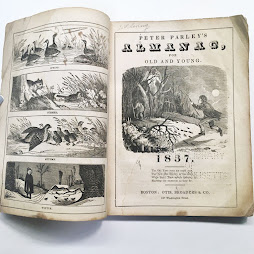
Peter Parley's Almanac for Old and Young, 1837

Fleet's Pocket Almanack for the year of our Lord 1789: Being the First after Leap Year and the Thirteenth of American Independence

Isaiah Thomas’s New England Almanac from 1797, 1800, and 1812 


Elizabeth Roscio
Preservation Librarian

Tuesday, January 2, 2024

On Display in the State Library

Happy 2024! It’s become a bit of a tradition at the State Library to begin the year by displaying some historical almanacs from our collection. This year, we’re sharing a few of the older ones in our collection, the 1796 and 1797 editions of Strong’s Almanack, which was compiled and calculated by Nehemiah Strong and published in Springfield (1796) and West Springfield (1797) by Edward Gray. The almanacs were calculated for Hartford, Connecticut and were distributed for use in Connecticut, Massachusetts, Rhode Island, New Hampshire, and Vermont.

We have chosen to display the 1796 almanac closed so that its cover is visible, while the 1797 almanac is opened to its page featuring January. The 1796 cover features a drawing of an astronomer holding an instrument and looking skyward, while standing on the banks of a body of water with a town in the background. A globe and other equipment are at his feet, and the night sky is shown above, complete with stars and the moon. Though we don’t know for sure, we can speculate that this may be a depiction of the compiler himself, Nehemiah Strong (1729-1807). From the article “Check List of Connecticut Almanacs, 1709-1850: With Introduction and Notes” by Albert Carlos Bates found in the 1914 edition of the Proceedings of the American Antiquarian Society, we learned that Strong was an astronomer and mathematician, and the first chair of Mathematics and Natural Philosophy at Yale University. Strong was a prolific compiler of various almanacs from 1775 until his death, and some of his former students from Yale also went on to compile almanacs.

The 1797 almanac is displayed open to the January page, which shows a listing of all 31 days, along with their moon phases and commentary on their predicted weather. The month starts off clear and cold on January 2 and 3 but January 4 is predicted to be more pleasant. Later in the month calls for snow, freezing temperatures, and even hail! Colonial Americans did not have their local meteorologist giving the forecast every morning on the news, so almanacs were extremely useful and popular publications that could be found in most households. Beyond astronomical and meteorological data, they also included useful information for the general public, like the listing of Superior Courts and Supreme Courts shown on the opposite page. And one of the more whimsical features of the almanac is a verse with stanzas that continue from month to month. 1797’s is titled The Lover and January’s entry reads, “Of all the things beneath the sun; To love’s the greatest curse; If one’s deny’d, then he’s undone; If not, ‘tis ten times worse.”  


If you’d like to start off your year with even more almanac content, then be sure to check out our previous posts. For 2023, we shared the 1815 and 1817 editions of The New-England Almanack, in 2022 we featured Peter Parley’s Almanac for Old and Young, in 2021 we highlighted Fleet's Pocket Almanack for the year of our Lord 1789, and in 2020 we showcased a selection of Isaiah Thomas’s New England Almanac, which can also be viewed in our digital repository. And if you are in the area, be sure to visit us from January 5 through the 31st to see Strong’s Almanack on display in our main library reading room.


Elizabeth Roscio
Preservation Librarian

Tuesday, January 3, 2023

On Display in the State Library

Happy 2023! For the past few years, we’ve started the new year by displaying some of the historical almanacs from our collection. This year, we’re going all the way back to 1815 and 1818 to display two editions of The New-England Almanack, which was compiled by Stoddard Capen, Jr. The publisher of these volumes varies over the run of years, but the ones in our collection were published and sold by Charles Callender in Boston (an appropriate name for someone selling almanacs!). The cover includes the notation that it was “calculated for the meridian of Boston, but will serve for any of the New-England states" and as such, the almanac was distributed and sold by booksellers throughout New England.

We've chosen to display the 1815 almanac (pictured here) closed, so that the front cover is visible. You likely recognize the image, as it is a variation of the Great Seal of the United States. While not identical to the official seal, the image shows a stylized version of an eagle with wings outstretched, a bundle of arrows and olive branch in its talons, and a shield with the American flag. From its beak is a scroll with the motto “E pluribus unum” which translates to “Out of many, one.” In keeping with the patriotic theme, the almanac identifies the year 1815 as “thirty-ninth of the Independence of the United States of America” which is the calculation of how many years had passed since the signing of the Declaration of Independence in 1776. 

Within the pages, The New-England Almanack provides much the same information as other 18th and 19th century almanacs, including lunar charts and weather predictions, and regional information like a listing of courts and lists of elected officials. However, it is the extra details found within the pages that make each of the almanacs in our collection unique and interesting, since each author selected different additional information that they thought would be useful and entertaining to their readers. To illustrate this, we’ve displayed the 1818 edition open to the page for January. The monthly chart lists moon phases interspersed with observable days like “Dr. [Benjamin] Franklin born” on January 17, 1706 and “Peter [the] Great died” on January 28, 1725. At the top of the page is a verse that describes the month, which for January reads in part as “fast falls the fleecy shower; the downy flakes, descending and with never ceasing lapse, softly alighting upon all below.” The verses continue from month to month and culminates in one long poem that describes the entire year.


On the facing page is some less typical information. This almanac lists out the vacation schedules and academic calendars for a number of colleges located throughout New England, such as Harvard, Yale, Brown, and Dartmouth. In the entry for Harvard, it also lists that “the public exhibitions of the students are in the college chapel, on the third Tuesday in October, the last Tuesday in April, and the Thursday preceding commencement, beginning at 11 o’clock A.M.” From what we can ascertain, this was a chance for students to present their work to the public, almost like a dissertation. Also of note are the pages following the monthly charts, which is a section titled “useful hints.” This includes a selection of miscellaneous tips like “rubbing cheese with red pepper prevents maggots” – which notes that rubbing cheese with butter and a red pepper, “gives a very fine colour to your cheese, but it is so pungent, that no fly would touch it.” There’s a food storage tip from 1817 to kick off your new year!

Visit us from January 6 through January 31 to see The New-England Almanack on display in our main library reading room, and if you’d like to start off your year with even more almanac content, be sure to check out our previous posts. In 2022 we featured Peter Parley’s Almanac for Old and Young, in 2021 we highlighted Fleet's Pocket Almanack for the year of our Lord 1789, and in 2020 we showcased a selection of Isaiah Thomas’s New England Almanac, which can also be viewed in our digital repository


Elizabeth Roscio
Preservation Librarian

Monday, January 3, 2022

On (Virtual) Display at the State Library

“Happy New Year! I wish you a happy new year!” Is the kind of greeting among friends on the first of this month, the commencement of a new year.” 

The introductory note in Peter Parley's Almanac for Old and Young, published in 1837, starts off with this festive quote. Following in the footsteps of years prior, we’re starting the year by sharing an historical almanac from our collection. Peter Parley was the pseudonym for Samuel Griswold Goodrich, a 19th-century author, publisher, and bookseller who also served as a member of the Massachusetts State Senate and House of Representatives. 

The contents of an almanac do not typically seem like the sort of publication that would appeal to a younger audience, but that is one way that Peter Parley’s differs from other almanacs. In addition to providing the sort of lunar charts and weather predictions found in most almanacs, this almanac includes a few extra details that makes it more accessible to younger readers. The title page shows the New Year chasing the Old Year into the woods, while Time looks on, and there are whimsical drawings for each month. We’ve included January here, complete with snowy hills and horse drawn carriages. Each month is also accompanied by two pages of text that describes nature (specifically birds and plants) to observe and activities to undertake. We especially liked this excerpt from January’s outdoor activities that describes the best way to construct a snowman:

Select from the wood-pile a forked stick, long enough for a full grown giant, say eight or ten feet; fix it upright with the forked end downwards. This is to answer for the skeleton; which you are to load with snow instead of muscles and sinews. Build up the figure with masses of snow to the shoulders of top of the stick, and here fix two sticks of a proper length for arms: cover these also with snow, and on top of all, place a huge snowball for the head. To enable you to reach high enough, you can roll up a large snowball or two, to stand upon. When you have added snow enough, with a shovel, shingle, or garden trowel, you can fashion the figure according to fancy, giving it a hat, a nose, mouth, &c., with eye-brows and a beard of moss, and a pipe to smoke if you like, by placing a long slender stick in his mouth, and coating it with snow.

The bulk of the almanac contains descriptions for each month, but the last twenty pages are comprised of “Varieties from my pocket-book” a collection of information that is described by Peter Parley as, “I have a habit of putting scraps that please me into my pocket-book. Among the collection that I have thus been making I find the following.” Included is everything from instructions to make hard water soft to an analysis of the meaning of the phrase “there is time enough” with random items like a list of things a farmer should not do in between. It is a miscellaneous listing of items with topics that are sure to appeal to readers of all ages! 

The copy in our collection has not been digitized, but we found a digital version available through Tufts University. Their version is identical to ours, except that it was printed in New York at Freeman Hunt & Co. and our version was printed right in Boston at Otis, Broaders & Co. on Washington Street. The last page of the Tufts version has been torn, so it is missing the last entries in Parley’s pocket-book. And if you want to kick off your year with even more almanac content, but sure to check out our post from 2020 on Isaiah Thomas’s New England Almanac and our 2021 post on Fleet's Pocket Almanack for the year of our Lord 1789: Being the First after Leap Year and the Thirteenth of American Independence. Happy New Year!


Elizabeth Roscio
Preservation Librarian

Monday, January 11, 2021

On (Virtual) Display in the State Library


Last January, our library display case featured a selection of almanacs published by Isaiah Thomas. This year, we are continuing our trend of starting the year with a historic almanac by featuring Fleet's Pocket Almanack for the year of our Lord 1789: Being the First after Leap Year and the Thirteenth of American Independence. Though we are not on-site and can’t physically change our display case, we’re happy for the opportunity to virtually share this item from our collection.

As represented in its name, Fleet’s Pocket Almanac was published by brothers Thomas and John Fleet and sold in their shop, The Bible and Heart, in Cornhill, Boston. Thomas and John were also the printers of the Boston Evening-Post, a newspaper that they took over from their father and ran until it ceased publication in April 1775. In The History of Printing in America (originally published in 1810), Isaiah Thomas wrote of the brothers that, “their father gave them a good school education; they were correct printers, very attentive to their concerns, punctual in their dealings, good citizens, and much respected.” They continued printing together until Thomas’ death in 1797. To read even more anecdotes and references to the Fleet brothers, be sure to check out their tag on Boston1775.

Fleet’s Pocket Almanac provides much of the same information that you’d expect to find in an almanac. There are entries on the year’s upcoming eclipses, the roads from Boston, and dates for the four seasons. Each month has a page for its moon phases and weather, along with “remarkable dates” of important anniversaries and holidays, like “Tea destroyed in Boston, 1773” for December 16 and Valentine’s Day on February 14. But there are also a few less traditional dates included, for example, the phrase “the dog days of summer” is commonly known as a way to describe the hottest days of summer, and in the almanac the “dog days” are noted as starting on July 25 and ending on September 3. 

But what is unique about Fleet’s publication is that after the almanac pages is the Massachusetts Register, which was published annually by various Boston printers from 1767 to 1878. It was published under the Fleet name from 1779 to 1800, at which point it was taken over by William Manning and James Loring. The Register was a comprehensive publication, similar in nature to a directory and almanac but also with a plethora of additional information. It would be a lengthy list to include everything found in the publication, but a sampling is that it provided statistics and data on currency, directions for the entrance of Boston Bay and sailing in and out of Plymouth, a tide table, as well as listings of various elected and appointed officials, religious assemblies, schools, attorneys, and sheriffs - it was truly a thorough annual resource.

While just the cover is shown here, you can virtually flip through the whole almanac and Register on DSpace! And click here to revisit our almanac post from last January, about Isaiah Thomas’s New England Almanac


Elizabeth Roscio
Preservation Librarian


Monday, January 6, 2020

On Display in the State Library


Almanacs provide a glimpse into the coming year, and as we turn the page to 2020, the State Library is looking back at some of the historic almanacs in our collection. On exhibit in the library through January 29 is a selection of Isaiah Thomas’s New England Almanac. Thomas published the almanac from 1775 through 1803, at which point his son continued publication through 1819.

Similar to today’s almanacs, these pamphlets look to the year ahead and provide tide, lunar, and weather data, along with important historical dates and general information or “anecdotes.” Anecdotes cover everything from human anatomy, to postage rates, to recipes for manure. Each month is depicted with an illustration and also includes a brief verse, poem, or narrative that continues as a serial from month-to-month. In an introductory letter from the editor in the 1797 edition, Isaiah Thomas wrote that “I have ever made it a practice to present you with something each year which should be worth more at the end of it than the price you gave for the almanac” and with all of the information provided, it seems as though he delivered on his word.

We are currently displaying the almanacs from 1797, 1800, and 1812. A close examination of the title pages of the 1797 and 1812 almanacs allow us to note the change in price over fifteen years – the almanac increased from 10 cents to 12 ½ cents for a single, and 75 cents to 87 ½ cents for a dozen. During this range of years, it is also important to note the change in publisher from Isaiah Thomas to his son, Isaiah Thomas, Jr. The 1800 almanac is on display opened to the January pages, in part so that we can compare our weather to what was predicted 220 years ago (snow on January 6-8, 13-18, and 25-29, along with “foul weather” on the 21 and 22).

Isaiah Thomas was born in Boston in 1749, where he was apprenticed at the age of seven to a printer named Zechariah Fowle. At the onset of the Revolutionary War, Thomas moved to Worcester where he continued his printing business. He was a participant in the Battles of Lexington and Concord, but he is also remembered as the founder of the American Antiquarian Society, a learned society and national research library that actively continues today. Thomas donated his papers, books, and newspapers to the AAS and served as its president until his death in 1831.

Frequently when an item goes on exhibit in the library, it needs a little bit of preservation work beforehand. But none of these almanacs needed any work by us because they recently underwent treatment at the Northeast Document Conservation Center (NEDCC). The State Library holds fourteen editions of the almanac, dating from 1797 to 1813. The conservators at NEDCC cleaned each one and mended any tears. The pages were resewn and then the pamphlet was digitized (and now available in our digital repository). The almanacs are now in much better condition, though they remain somewhat fragile and the library must limit their use and handling. We are thrilled for the opportunity to display a selection of them this month in our special exhibit case. 

By Elizabeth Roscio
Preservation Librarian