Tuesday, October 30, 2012

Broadsides Are Now Available on Flickr


The State Library’s Special Collections Department has a collection of nearly 190 broadsides, which are single-sheet printed documents, usually eighteen to twenty inches high by fifteen or sixteen inches wide, that historically were posted on walls or carried, rolled up, to distant places. The subject matter of these broadsides is diverse, ranging from governmental communications and political election notices to poems, memorials, odes and addresses, and even commercial advertisements. The State Library's collection of broadsides contains materials ranging from the time of the American Revolution to more recent gubernatorial proclamations.

A few of the State Library’s broadsides have been digitized and are now available for public viewing on the library’s Flickr page and online repository. If you would like to view the broadsides in person, please visit the State Library’s Special Collections Department in Room 55 in the State House, which is open Monday-Friday, 9am-5pm.

- The Marketing Committee

Monday, October 22, 2012

Technological Revolution

Images from these two books on invention appear in our new Flickr set. 
Visitors familiar with State Library exhibits will recognize the cover for “Great Inventions,”
which appeared in our decorated bindings exhibit.

Today in the 21st century, it takes a lot for a product to impress us.  Recently, Apple released the newest version of the iPhone- a cordless, pocket-sized personal telephone that can also display and record video, take pictures, send and receive messages, connect you to endless amounts of information on a global network, give you directions, even speak back to you when you give it a command… and the world is less than impressed because other devices let you do all of that, but faster, and with a (let’s face it) cooler feature of touching phones together to send information.  Incredible!  So how have we become so bored?

In the 19th century, the endless opportunities made possible by the technological revolution awed many. Strides were made in the advancement of automated transportation, mass manufacturing of fabric and clothing, standardized means of preparing print materials, the means to examine the world’s natural elements, and so much more.  Suddenly, the notion of convenience was everywhere. The machinery that made all of this possible was shocking and newsworthy because now a variety of machines from simple to complex were able to do things better than a person ever could.

Take a look at our newest flickr set to marvel at a few 19th century inventions from familiar to strange, and visit the State Library's Special Collections department to discover more wonderful illustrations in our books on patents, industry, and inventions.

Thursday, October 18, 2012

Brown bag on the 2010 Census and the American Community Survey

Join us for a Brown Bag Lunch
on Thursday, October 25th, 2012
State Library of Massachusetts
Room 442, State House
12 until 1:30 PM

Bring your lunch and join us to hear Alexandra Barker, Data Dissemination Specialist at the New York Regional Census Office, speak on the most current demographic and socioeconomic data for Massachusetts. She will speak specifically about the results from the 2010 Census and the American Community Survey which provide a picture of the population and the socioeconomic trends in the state. As part of the presentation, Mrs. Barker will go over the data resources available for you online, including economic and business data.

To register, please go to http://www.surveymonkey.com/s/SV3RW8D
You may also register by calling the Reference Department at 617-727-2590 or by e-mailing to Reference.Department@state.ma.us 

Future Brown Bags will include:
  • Thursday, November 15th 
    Dr. Marcia Hohn, The Immigrant Learning Center, Massachusetts Immigrant Entrepreneurs
  • Tuesday, December 11th Dr. Beryl Rosenthal,  Executive Director, The Waterworks Museum, The History of Water in Massachusetts

Thursday, October 11, 2012

Economic Report of the President

The economic report of the President has been produced since 1950.  It is an annual report written by the Chairman of the Council of Economic Advisers and is released together with the report of the Council.  The report is issued by the Executive Office of the President. 


The report includes information about:
  • annual numeric goals
  • programs to carry out program objectives
  • employment objectives for some of the labor force
  • current and future trends; annual numerical goals about employment, production; real estate and Federal budget outlays.
Included in the subjects listed above are reports on:  tax policy; alternative energy; health and health care; credit; housing markets and export growth.

The volume contains over 100 tables of information with multiple years of analysis/statistics covered.  Each table starts in a specific year and covers time from that year to the present.  An example is below 
  
Table B-17. Real personal consumption expenditures, 1995-2010. Economic Report of the President, Transmitted to Congress, February 2011; House Document 112-2.
The report is available online at:  www.fdsys.gov.  Click on the icon on the right side of the page that says “browse collections.”  The Economic Report of the President is there from 1995 to the present.

The State Library holds paper copies of this publication as well as access to the online documents.  We invite you to room 341 of the State House to access this Federal document.  We are open Mondays through Fridays from 9 am to 5 pm.

Thursday, October 4, 2012

Explore Online State Documents with DSpace


Did you know that many state publications are available full-text online?  The State Library maintains an online repository, commonly known as DSpace, which currently contains over 115,000 state documents, with more being added each week.


The majority of the documents in the online repository are the Acts and Resolves Passed by the General Court of Massachusetts. You may view the full text of all of the Acts and Resolves from 1692 to the present.  Other collections of interest include the Manual for the General Court (1858-present), the Massachusetts Election Statistics (1890-present), the Annual Reports of the Attorney General (1832-present), and the recently digitized Massachusetts Real Estate Atlases.

Navigating DSpace is simple due to the repository’s organizational structure. The documents in DSpace are organized first according to the name of the state agency that published the document, then according to the type of publication, such as annual reports, meeting minutes, or press releases, to name a few.  

If you aren’t familiar with the hierarchy of state agencies, don’t worry!  You can expand the list of state agency names by browsing the communities and collections. Then simply search (Ctrl-f) the list for whichever state agency you need. Keep in mind that DSpace only displays the five most recently uploaded publications in each collection.  To view all of the items in a collection, simply browse by issue date, author, or title.

Although not every state publication is available online, the State Library is dedicated to providing greater access to state publications electronically.  To meet this end, the State Library has several ongoing digitization projects, and the librarians at the State Library are continuously working to capture state documents as they are published online for permanent preservation in DSpace.  

If you have any questions about finding online publications in DSpace, please email the State Library at reference.department@state.ma.us or give us a call at 617-727-2590.

- The Marketing Committee

Monday, September 24, 2012

The Women’s Suffrage Movement in Massachusetts

This past August 26th marked the 92nd anniversary of women’s suffrage in the United States! In 1920, the Nineteenth Amendment of the U.S. Constitution was passed, which prohibits the denial of any citizen’s right to vote based on sex. While 92 years seems like such a long time ago, in retrospect it’s still very much recent history. Massachusetts was a hotbed for suffragist activities during the mid-to-late 19th and early 20th centuries, and the state was home to many notable women leading and influencing the cause. For example, in 1870, after forming the American Woman Suffrage Association in 1869 (later becoming the National American Woman Suffrage Association), activists Lucy Stone, Henry Blackwell, Julia Ward Howe, and other supporters of the movement formed the Massachusetts Woman Suffrage Association. These groups worked together, sharing goals and partaking in the same educational, promotional, and legislative lobbying activities that helped push the topic of women’s enfranchisement forward on both state and national levels.

Here are a few more interesting facts about suffrage activities in Massachusetts:

• In 1850, the first National Women's Rights Convention was held in Worcester.

• In 1868, the New England Women’s Club and the New England Woman Suffrage Association were founded in Boston.

• In 1869, a Joint Special Committee on Woman Suffrage was formed by the Massachusetts legislature. A list of committee members can be found in the 1869 manual of the General Court.

• In 1871, William Claflin became the first governor of Massachusetts to speak publicly and directly about woman’s rights as a citizen.

• In 1879, Massachusetts passed a law that allowed women to vote for school committee members. In that same year, Louisa May Alcott was the first woman to register to vote for the Concord School Committee election in Massachusetts.

• In 1888, an act was passed to incorporate the National Woman Suffrage Association of Massachusetts, founded by Harriet Hanson Robinson.

• In 1895, an act was passed that authorized persons qualified to vote for school committee members to vote on the question of granting municipal suffrage to women at the next state election—this act meant that women could now vote on the issue.

The library has a large collection of materials on the history of women’s suffrage. Some of the most interesting items are bound pamphlets supporting and opposing the movement. One pamphlet’s title, published by the Women’s Anti-Suffrage Association of Massachusetts, glaringly claims “Woman Suffrage a Menace to Social Reform”. Another pamphlet from 1909 by the Illinois Association Opposed to the Extension of Suffrage to Women states, “Unable in spite of heroic efforts for the past twelve years to gain a noteworthy legislative advance, [Suffragists] have been at last impelled to call in the aid of the militant Suffragists of England, and in New York and Massachusetts are adopting, to a certain degree, their noisy and ill-mannered tactics.” A great example regarding British Suffragettes is Nelson Harding’s 1914 “Ruthless Rhymes of Martial Militants”. A note from the author describes his disdain for militant Suffragettes:


Grimly vindictive, the militant rages
In pitiless wrath through the following pages
Benighted termagant, seeking applause
In the name of an honest and suffering cause


Kaitlin Connolly
Reference Department

Monday, September 17, 2012

Massachusetts Real Estate Atlases Now Online


The State Library recently completed the scanning of forty-five real estate atlases covering communities throughout Massachusetts. These atlases are now available online through the library’s institutional repository and its Flickr site. This is part of a grant-funded project to digitize the approximately 200 real estate atlases in the State Library’s collection. The items that are now available include a statewide atlas and municipal volumes that cover cities and towns throughout the Commonwealth, from Attleboro to Pittsfield.

The image on the top detailing the area where the Mystic River and Chelsea Creek flow into Boston Harbor is from the 1892 Atlas of Massachusetts published by Geo. H. Walker & Co.

These atlases are a useful tool for genealogists, architectural consultants, and those researching the history of their homes, as they provide information about property boundaries, plot size, ownership and building shapes and materials. The image below, taken from the City atlas of Lowell, Massachusetts (published by G. M. Hopkins in 1879) illustrates properties, including mills and other industry along the Concord River in Lowell.


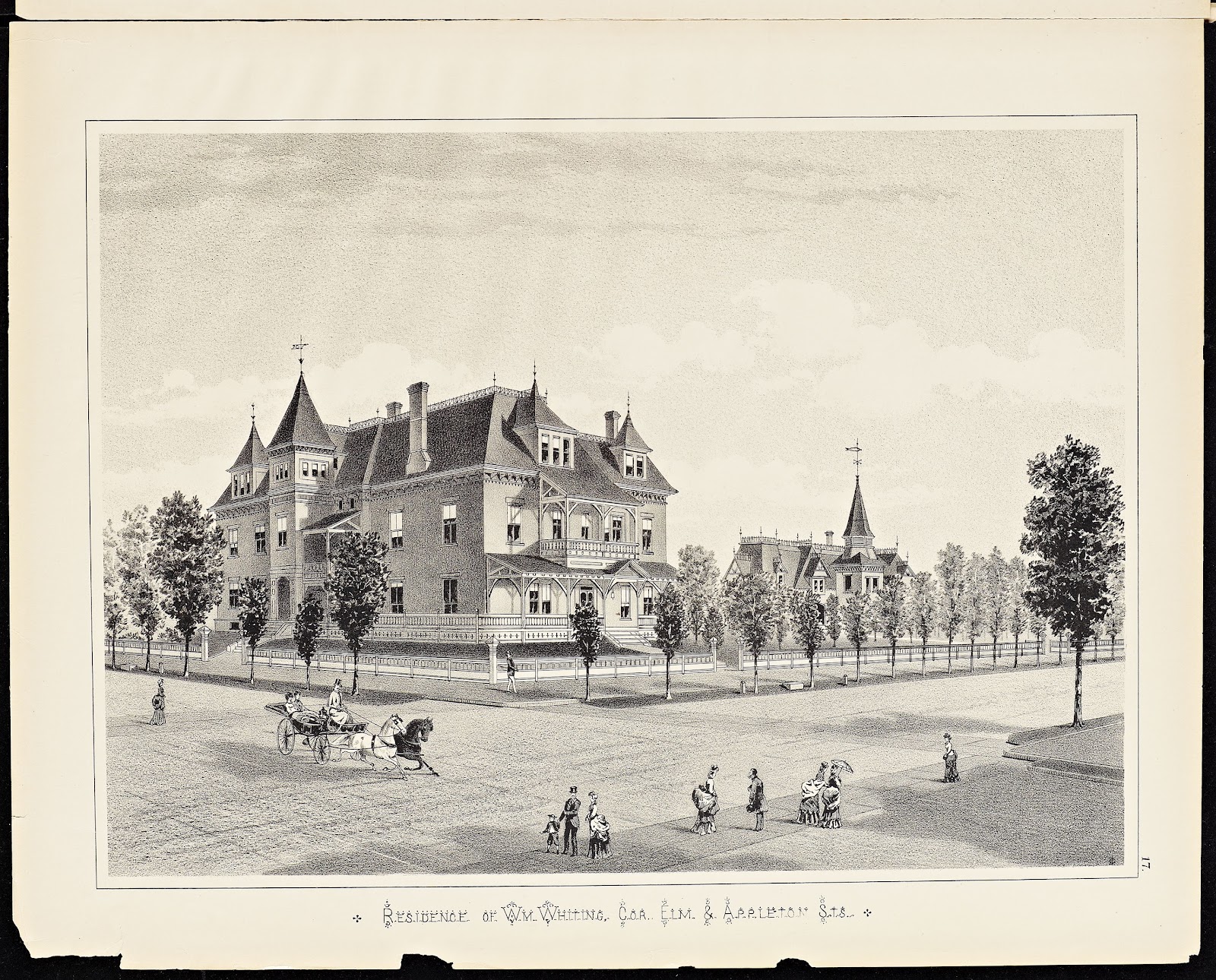
Some of the atlases also include drawings of prominent homes, schools and other important buildings. An example of this is the residence of Wm. Whiting found in the 1884 Atlas of Holyoke City, Massachusetts published by Geo. H. Walker & Co.


The Massachusetts real estate atlas digitization project, to be completed by the summer of 2013, has been developed with federal funds provided by the Institute of Museum and Library Services and administered by the Massachusetts Board of Library Commissioners.