Monday, December 30, 2019

January Author Talk: Vincent Brown


Tacky's Revolt: The Story of an Atlantic Slave War by Vincent Brown
Tuesday, January 14, 2020—Noon to 1:00pm
State Library of Massachusetts—Room 341, Massachusetts State House


The State Library’s first author talk of 2020 will feature Harvard Professor Vincent Brown, author of Tacky’s Revolt: The Story of an Atlantic Slave War. This new book is scheduled to be released on the same day as our author talk, on Tuesday, January 14.

As described by the publisher, Tacky’s Revolt is a gripping account of the largest slave revolt in the 18th-century British Atlantic world. This uprising laid bare the interconnectedness of Europe, Africa, and America, shook the foundations of empire, and reshaped ideas of race and popular belonging. The book focuses on a movement of enslaved West Africans in Jamaica who organized an uprising in 1760 that featured guerrilla-style warfare and which was part of a more extended borderless conflict that spread from Africa to the Americas and across the island. Tacky’s Revolt traces the roots and reverberations of this insurgency and expands our understanding of the relationships among African, European, and American history.

Author Vincent Brown is the Charles Warren Professor of American History and Professor of African and African American Studies at Harvard University. Dr. Brown’s first book, The Reaper’s Garden: Death and Power in the World of Atlantic Slavery, won the James A. Rawley Prize, the Merle Curti Award, and the Louis Gottschalk Prize. His documentary, Herskovits at the Heart of Blackness, which was broadcast nationally on the PBS series Independent Lens, won the John E. O’Connor Film Award and was chosen as Best Documentary at both the Hollywood Black Film Festival and the Martha’s Vineyard African-American Film Festival.

We invite you to register today and join us at the State Library at noon on January 14 for Dr. Brown’s talk and book signing.

Laura Schaub
Cataloging Librarian

Our upcoming Author Talks:
https://www.mass.gov/service-details/upcoming-author-talks-at-the-state-library

Tuesday, December 24, 2019

Monday, December 23, 2019

Artificial Intelligence and Libraries

HAL9000 from the movie 2001:
A Space Odyssey.  (Image from
Wikimedia Commons)

artificial intelligence:  a branch of computer science dealing with the simulation of intelligent behavior in computers (Merriam Webster)

bias:  an inclination of temperament or outlook especially : a personal and sometimes unreasoned judgment : PREJUDICE (Merriam Webster)

Back in early November I attended the Law Librarians of New England (LLNE) fall 2019 meeting that focused on artificial intelligence (AI) and algorithms in law libraries and legal practice.  AI is and will continue to be a hot topic with the development of “deep fakes,” facial recognition software, Alexa and Siri, targeted advertisement, and self-driving cars.  But how does AI affect libraries and their patrons?

Google’s algorithms use the billions of searches users perform on a daily
bases as data and learn from them in order to predict and/or suggest future searches.

AI has revolutionized both the ways in which we seek information and the speed at which we receive it.  When you use a database or search engine, however, you most likely aren’t thinking about the algorithm that is being used to retrieve results for you, who created the algorithm, and what kind of data it’s drawing from.  I left the fall meeting realizing that everyone should be asking these types questions.  There’s a dangerous expectation that computer and web-based programs are designed to give the user impartial results that represent the truth; however, what if an algorithm intentionally or implicitly reflects the bias of its creator and/or the biases fed into it by its millions of users?  University of Southern California communications professor Safiya Umoja Noble, for her book Algorithms of Oppression, spent 6 years researching Google’s search algorithms and found that the tool not only tends to reflect the values of white western men, who also make up the majority of its builders, but also fails to represent--and even perpetuates negative stereotypes of--minorities and women.  This is a problem that extends far beyond Google, which is why it’s important to consider the objectivity of the pipeline that is delivering information to you.

Another issue with AI is the lack of standardization and transparency.  Librarians love standardization, which is why there are rules for metadata creation that cataloging librarians across the world follow to create access to library materials (for example: MARC records and Library of Congress subject headings).  Library catalog records are usually completely transparent and users can see the “code” used to index an item.


Proprietary companies understandably do not want to share the secret inner workings of their products, but this poses a problem when the user wants to better understand why one database pulls X results while another database pulls Y results, or why the results are listed in a certain order, and most importantly where this data is coming from and if its complete.

Admittedly, I myself still know so little about AI and there are so many different facets and ethical and privacy issues to consider, but what I do know is that it’s important for library users from all backgrounds and disciplines to be aware of the repercussions of too much reliance on it when seeking information.  DON’T assume that AI is smarter than you, DO assume the probability of bias, DON’T assume that it draws from an exhaustive bank of quality data, and DON’T assume that having difficulty finding something in a search engine or database means that it doesn’t exist.

Kaitlin Connolly
Reference Department


Further reading:


Monday, December 16, 2019

Boston Female Asylum: Records of Benevolence

December is the time of year that resonates with giving and helping out our fellow neighbor.  The history of benevolence runs deep in the Commonwealth of Massachusetts, and the State Library has the records to show the power of what a small group of women can do to help improve the lives of others.  This blog post highlights the Boston Female Asylum records.  The story of the Boston Female Asylum is about how the act of community organization built an enduring charitable institution.

The Boston Female Asylum (BFA) was officially established in 1800 and incorporated in 1803. The BFA was the first public charity planned and established by women in the town of Boston.

Photo: Tom Nichols
In early December of 1799, a letter by Mrs. Hannah Stillman printed anonymously in J. Russell’s
Gazette suggested that the ladies of Boston organize a society similar to one recently established in Baltimore for the care of the “fair fragile form.”

Mrs. Stillman was the wife of Reverend Dr. Samuel Stillman, of the First Baptist Church of Boston.  The Stillmans had fourteen children and at 60 years of age, Hannah decided to form the Boston Female Asylum Society to help orphaned and destitute girls in Boston.  Although other women joined Mrs. Stillman, it was difficult to a get them to give their names for a published record because it was the first time that women had assembled for any public purpose. 

The first meeting for the purpose of forming the society was conducted at Mrs. Jonathan  Mason’s (Senator) house.  Mrs. Stillman asked for donations and helped establish a subscriber system where prominent women in the community became members by paying an annual $3.00 subscription fee.  Further donations would be accepted from women and men- “although gentlemen could not be members of this society, their names will be entered with peculiar pleasure on the list of its benefactors.”  The society took off quickly and at the second meeting, the first child, Betsy D. was admitted.


Seeing so much need in Boston, the BFA developed swiftly and unanimously voted in Hannah Stillman to serve as its first director until her death in 1821.  Rev. Stillman noted at the first anniversary of the founding of the Asylum that girls “are to be placed under the care of a discreet, capable and virtuous Governess.”  When the children reached the age of ten, managers of the Asylum would place the children under the care of “good and virtuous families, till they shall be eighteen.”  During its first year, the BFA took in 13 girls and helped hundreds over the decades.

The State Library of Massachusetts received the records of the Boston Female Asylum in 1926. The State Librarian, Edward H. Redstone, announced in the Boston Daily Globe how fruitful this collection would be for researchers of all disciplines. This fascinating collection has the register of orphans admitted to the BFA, sermons and other publications, an expense ledger, register of subscribers, donation account and the board of managers meeting records.

Subscribers and donors over the years included, First Lady Abigail Adams, Mrs. John Quincy Adams, Mrs. Elizabeth Adams wife Governor Sam Adams, and several other well known families of Boston.

Another very interesting piece of history from this collection is the ledger of monthly expenses.  The ledger shows what food and other necessities were purchased to care for the orphans over the span of several decades.  This documentation was very detailed and helps researchers see what particular items were used during this time and how much it cost to care for all the girls.

The BFA was a very active organization that changed with the times. From 1800 to 1811, the children were lodged in houses contracted by managers.  The BFA was first established in a house on Pleasant Street in Boston.  From Pleasant Street, the Asylum moved to Summer Street, then to South Street, and then to Lincoln Street.  In 1811, the Society purchased the estate of Daniel Sargent on or near Lincoln Street for $12,000.  In 1844, the Society purchased a lot in the south part of the city and built its own building.  The cornerstone was laid for this building at 1008 Washington Street on June 25, 1844.

The volunteer nature of the Asylum gave way to the hiring of professional social workers.  In 1902, all girls were placed in private homes, and the building on Washington Street was closed.  In 1910, the name of the Asylum was changed to the Boston Society for the Care of Girls.  This Society joined with Children’s Aid Society in 1922.  Soon it would form the Children’s Aid Association, later to become Boston Children’s Service Association.  In the 2000s Boston Children’s Services, New England Home for Little Wanders, Parents’ and Children’s Services, and Charles River Health Management merged into The Home for Little Wanders, which provides a variety of services in Massachusetts.


                                                              For further reading:

 BFA. (1844). Reminiscences of the boston female asylum. Unpublished manuscript.

Boston Female Asylum. (1989). Boston female asylum: Historical account, by-laws, rules and regulations. Boston: Beacon Press.

Boston female asylum records (1800- 1866) located at the State Library of Massachusetts

Mock, E. (1979). Survey, inventory and guide to the records of the Boston Female Asylum and the Boston Society for the Care of Girls. Boston: University of Massachusetts at Boston.


Dava Davainis
Head of Reference

Monday, December 9, 2019

Popular Databases and How to Find Them

The State Library has been working hard to get many state publications and legislative history materials digitized and available online. In addition to these collections, we have access to several online databases that provide state employees and other patrons with access to academic journals, magazines, and newspapers. All you need is a State Library card!

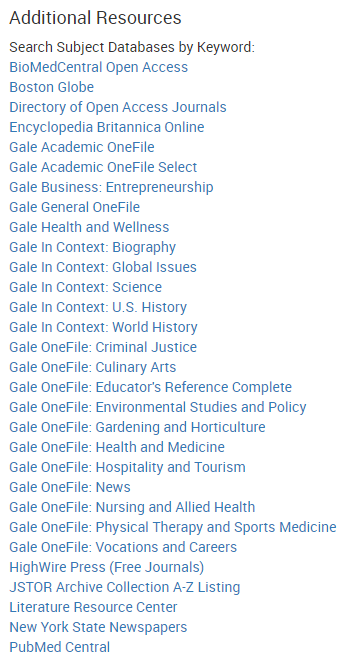
The State Library provides access to legal and legislative databases and news sources like MassTrac/Instatrac, Westlaw, and the State House News Service. However, these online resources can only be used in the State Library’s Reading Room. In contrast, the State Library also provides access to several other databases not necessarily related to legislative history and research courtesy of the Massachusetts Board of Library Commissioners. These databases include JSTOR, BioMedCentral, PubMed, and several Gale academic databases that focus on subject-specific content. Further, patrons can access these databases remotely, either at home, in their office, or elsewhere outside of the State Library, using their State Library card.

You can access these databases here.

But how can you check and see what those databases have access to? If you are interested in journals and journal articles, you can search for a specific title without clicking into each individual database. Simply navigate to the first search bar and “Search by Title or Identifier”:


You can select search parameters such as “Title begins with” or “Title equals” and then enter the name of the journal you are interested in. If the journal is included in any of the databases, it will be listed as a result along with date range information and a link to the database that provides access.


You may notice that the date range of content available may not be completely up-to-date. This is because journal publishers often negotiate agreements with database companies about what content they can provide access to, as publishers often sell their own subscriptions to current journals and other materials. Because of these agreements, the database may only be able to provide articles published after a specified time period. This delayed access is referred to as an “embargo” or “moving wall.” If a journal is impacted by an embargo, this information should be listed on the journal’s page on the database.

This journal on JSTOR has a 3-year “moving wall”
embargo. In addition to this journal-specific
information, JSTOR helpfully provides more information
about different types of publisher embargoes.

If you are unsure what the specific journal title might be or would like to browse all journals available, you can do so alphabetically or by subject on the main database webpage:


The journal you are interested in may not be located in any of the databases we have access to – but don’t worry! If that is the case, you can always request a journal article via our ILL service.

If you are not interested in a specific journal or magazine but want to explore individual articles or topics, you can also select a general database at the bottom of the page:


These links will bring you to the database’s general page, where you can perform basic or advanced searches regarding whatever you are looking for. Some of the databases are focused on a particular topic, such as Gale OneFile: Criminal Justice or PubMed Central, which is a medical database. Other databases may include just one type of online resource, such as the Boston Globe, the Encyclopedia Britannica, or New York State newspapers. The Directory of Open Access Journals is the only database listed here that does not require your State Library card, as all of its content is “open access” and therefore publicly available.

The homepage for Gale’s Academic Onefile database.

You may notice some date range restrictions similar to embargoes for some of these databases. For example, ProQuest only provides access to the Boston Globe from 1980 to present. If you are interested in articles earlier than 1980, you may want to check to see if your public library, university, or college provides their own access the Boston Globe. Public libraries and schools often have their own subscriptions to different databases and online resources and will be happy to share their services with you.

If you have any questions about the State Library’s databases or how to use them, feel free to contact the Reference Department at 617-727-2590 or email us at reference.department@mass.gov.


Alexandra Bernson
Reference Staff

Monday, December 2, 2019

On Display in the State Library

Visit the State Library from December 2 to December 31 to see our next displayed item – Map of Massachusetts, Connecticut and Rhode Island: Constructed from the Latest Authorities. Published in 1825 by Anthony Finley, the cartographer was David H. Vance and the map was engraved by James Hamilton. Since this map, and others published by Finley, was based on the latest authorities, it could be counted on to be precise and accurate. The counties located within each state were hand colored, and nearly two hundred years later the map is still a vibrant representation of New England.


In addition to identifying county boundary lines, towns, and geographical features of each state, this map also provides interesting information about population growth in the early 1800s. The population size of each county found in Massachusetts, Connecticut, and Rhode Island, as well as an overall count for the entire state, is listed for both 1810 and 1820. This data was likely compiled from the Federal Census, which continues to be taken every ten years. From 1810 to 1820, Massachusetts increased from 472,040 to 521,725, Connecticut increased from 261,924 to 275,248, and Rhode Island increased from 76,931 to 83,059. The increase in each of these states during the ten year span matches the general population increase that occurred in the United States, which experienced about thirty-three percent growth.

Before the map went on display, it needed to undergo a fair bit of preservation treatment. It had previously been pieced together with adhesive tape and fabric, so we worked carefully to remove as much of those materials as possible. Surface dirt had accumulated after years of handling, so the map was also cleaned, and tears and paper loss were mended with thin Japanese paper and wheat paste.

Anthony Finley was a prolific map publisher, including a map of the United States in 1827 and Massachusetts in 1831, which is also part of the library’s collection. The State Library has an extensive map collection, which can be searched on our online catalog and through our digital repository, DSpace. And visit us through the end of December to see this map in person. If you’re from southern New England, be sure to find your own town and county!

By Elizabeth Roscio
Preservation Librarian


Monday, November 25, 2019

More than Gerrymandering: Elbridge Gerry

When most think of the “Founding Fathers,” they think of very famous central figures: George Washington, Sam Adams, John Adams, or Benjamin Franklin, to name a few. However, many other politicians other than these oft-remembered names were responsible for shaping the early years of the United States government and Massachusetts statehood. One of those figures is Elbridge Gerry.

Elbridge Gerry was born in Marblehead, Massachusetts in 1744 and, like many of his contemporaries, attended Harvard College. His father was a merchant who traded with many countries overseas, and Gerry became an active opponent to the taxes and laws that the British sought to implement surrounding American trade. In fact, Marblehead was almost as politically rebellious as Boston and resisted the British economic sanctions just as fiercely, which is understandable as it was an extremely important port and fishing town. It comes as no surprise, then, that Elbridge Gerry helped to begin the first committee of correspondence outside of Boston in his hometown, and when the port of Boston was closed in punishment for the Boston Tea Party protest, Gerry played a lead role in establishing Marblehead as an alternative port and transporting supplies to the people of Boston marooned under martial law.

Portrait of Elbridge Gerry from our Flickr set
Images of the Governors of Massachusetts, 1629-1894

During this time, Gerry was elected to the Massachusetts General Court and was later elected to the provisional Massachusetts Provincial Congress when the colony’s legislature was dissolved by General Gage in 1774. As part of the Congress’ committee of safety, he helped to collect weapons and munitions and store them in Concord before the Battle of Lexington and Concord. After the American Revolutionary War began, Gerry continued to coordinate supplying the Continental Army, made possible with his knowledge and connections in the shipping industry.

In 1776, Elbridge Gerry became a delegate for the Second Continental Congress, serving alongside John Adams, Sam Adams, John Hancock, and Robert Treat Paine. He fought hard to convince his fellow delegates to support the passage of the Declaration of Independence and was one of the five Massachusetts men to sign it. John Adams, a lifelong friend to Gerry, wrote that “If every Man here [at the Second Continental Congress] was a Gerry, the Liberties of America would be safe against the Gates of Earth and Hell” (John Adams to James Warren, July 15, 1776, Warren-Adams Letters, Massachusetts Historical Society). Adams, as well as Gerry’s other friends, considered him “a loyal and dependable friend, and a man of consistent political principles,” according to biographer George Athian Billias.

These principles were put to the test during the Constitutional Convention in 1787. As the delegates debated the framework of the new American government following independence, Gerry stood fast and opposed measures like the Three-Fifths Compromise, disgusted that the Southern States would insist on counting slaves as part of their population to increase their legislative representation while still maintaining that these people were property. Throughout the Convention he debated elections and governmental structure, successfully arguing to give the U.S. Congress’ power to override presidential vetoes. But primarily, he was most concerned about the lack of protections for personal rights and liberties. Gerry became a hugely controversial figure when he was one of only three delegates who refused to sign the U. S. Constitution. Further, he then wrote a letter to the Massachusetts Legislature articulating why he refused to sign, stating among his reasons that the document had “no adequate provision for a representation of the people.”

The U. S. Constitution (second printing) with annotations by Elbridge Gerry (1787),
courtesy of the Massachusetts Historical Society.

This letter was widely circulated, going through 46 printings and is considered one of the most popular Anti-Federalist tracts. However, it certainly made him many enemies among Federalists, and he was not a popular figure in the Federalist-dominated Massachusetts convention to ratify the Constitution. The debates were particularly contentious, almost erupting into a brawl between Gerry and convention chair Francis Dana when the former was not allowed to speak. Gerry left the convention, and the Commonwealth ratified the U.S. Constitution, though only with recommendatory amendments. Estranged by many in the Massachusetts political elite, he still had enough friends to be nominated for a seat in the U.S. House of Representatives, where he worked tirelessly on the first ten amendments to the U.S. Constitution. These amendments, introduced by James Madison, are now known as the Bill of Rights and were exactly what Gerry felt the U.S. Constitution lacked. With the implementation of these amendments, Gerry felt vindicated his beliefs and withdrew his opposition.

Elbridge Gerry remained a controversial figure in early American politics, retiring and reentering the political field several times and repeatedly running for governor unsuccessfully. Speculation about his involvement with the XYZ Affair (1797-1798) further damaged his reputation despite support from John Adams and Thomas Jefferson. Gerry had avoided joining a political party following the decline of Anti-Federalists, but finally aligned himself with the Democratic-Republicans in the early 1800’s. With their support, he finally became Governor of Massachusetts in 1810, calling for an end to partisan warfare.

Elkanah Tisdale’s famous cartoon of the Gerry-mander,
originally published in the Boston Centinel, 1812.

Ironically, then, did his term as governor become defined by partisan warfare. With war with Britain looming, Gerry became more and more distrustful of Federalists and replaced many within the state government with Democratic-Republicans. It was at this time that he inspired the phrase “gerrymandering,” the practice of manipulating district boundaries in order to establish a political advantage for a particular party or group. This controversial practice certainly did not originate in Massachusetts, but the name stuck thanks to Gerry’s enemies. In 1812, the Democratic-Republican-controlled Massachusetts Legislature passed a redistricting bill in which senatorial districts were carved into new shapes that would benefit their party in future elections. Gerry signed the bill into law reluctantly, believing that as governor he should not veto laws unless they were unconstitutional, but that did not stop his Federalist opponents from blaming him for the new partisan districting. According to an 1892 article by John Ward Dean, an illustrator, ridiculing the shape of one of the new districts in Essex County, drew the district into a dragon-like beast. Someone remarked that the beast looked like a salamander, while another corrected that it looked more like a “Gerry-mander.” Today, we still refer to the creation of partisan districting as “gerrymandering.”

Gerry was not reelected as governor in 1812, though he did become James Madison’s running mate in the presidential election of the same year. He became the Vice President in 1813, but was only in office for less than two years before he died November 23, 1814. Despite his involvement in the Continental Congress, his work to amend the U.S. Constitution to protect individual rights, and other diplomatic and political work throughout his life, he is still widely remembered for his connection with partisan redistricting, a law he did not support in the first place.

Further Reading:


Alexandra Bernson
Reference Staff