Showing posts with label FY2025 monthly exhibit. Show all posts

Monday, June 2, 2025

For Juneteenth – The Emancipation Proclamation

This month, our Collection Spotlight case recognizes Juneteenth, the federal holiday that commemorates the ending of slavery with the final enforcement of the Emancipation Proclamation in Texas on June 19, 1865. We are displaying the copy of the Emancipation Proclamation found in our collection, which was published as a pamphlet by the War Department on January 2, 1863, and distributed to the Army.

In the midst of the Civil War, President Abraham Lincoln issued the Preliminary Emancipation Proclamation on September 22, 1862 stating his intention to free all individuals held as slaves in secessionist states on January 1, 1863. The Emancipation Proclamation itself was then issued on January 1, 1863. The version that we hold in our collection was published the following day by the War Department with the notation that “The following Proclamation of the President is published for the information and government of the Army and all concerned.” The proclamation was relevant to the War Department because also within it was the announcement that freed Black men could enlist in the Union Army and Navy. Later in January, following the enactment of this provision, Massachusetts governor John Andrew received permission from the U.S. War Department to raise a Black regiment as part of the Union Army. Enlistment began in February, and those who joined became the 54th and 55th Massachusetts Infantry Regiment. You can read more about those regiments, and see some photographs of enlisted soldiers, in previous blog post.

Juneteenth is celebrated on June 19, 1865, the date that marks the official end of slavery, when General Gordon Granger and Union troops arrived in Galveston, Texas and enforced the Emancipation Proclamation, over two years after it was initially issued. Since then, Black communities have gathered on that date to celebrate Juneteenth as an Independence Day. Part of those celebrations sometimes includes a reading of the Emancipation Proclamation, which is why we have chosen to display it this month. You can read more about Juneteenth on the National Museum of African American History & Culture website, and view the original Emancipation Proclamation at the National Archives.

Visit us from June 3 through July 1 to see the Emancipation Proclamation pamphlet on display. Though only the first page of the Emancipation Proclamation can be exhibited, we have included facsimiles of the subsequent two pages. Also on display is a copy of the official proclamation issued by Governor Charlie Baker in 2020, which established Juneteenth Independence Day as a state holiday. The following year, President Joe Biden signed the Juneteenth National Independence Day Act into law, establishing Juneteenth as a federal holiday.


Elizabeth Roscio
Preservation Librarian

Monday, April 28, 2025

On Display for AAPI Month and Preservation Week

This month, our Collection Spotlight item is pulling double-duty, and is highlighting both May’s designation as Asian American and Pacific Islander Heritage Month (AAPI Month), and this week’s celebration of Preservation Week (April 27 through May 3). We are once again displaying the 1930 and 1931 editions of the Chinese Directory of New England, which was previously displayed in 2022. The directories help us to draw attention to the rising Chinese-American population in New England in the early 1900s, and this blog post also discusses the ways in which the library deploys preservation measures to ensure their stability for years to come. 

The 1930 directory was the first of its kind to be published in New England, and it was born out of a call from the growing Chinese-American community to have a resource that would list Chinese restaurants, stores, and laundries found within individual New England towns. Also found within the pages of both the 1930 and 1931 directory are advertisements, the bulk of which are for Chinese-owned businesses, but there are also a fair amount for non-Chinese owned businesses. This emphasizes that these business owners acknowledged the importance of New England’s Chinese residents as a vital part of the community and economy. And here at the State Library, we appreciate that the directory also includes an image of the State House, and find it fitting that a copy of the directory ended up in the collection here. Read more about these directories in our previous blog post


To ensure the long-term preservation of these directories – which are approaching their 100th birthday – we have displayed them open to different pages than they were three years ago. This decreases the amount of light damage to the directories, but it should also be noted that our Collection Spotlight case is designed to limit light and UV exposure, thus making it safe to display items. When these items are not on display, they are housed in dark storage in their own enclosures, to ensure that they do not get dusty. In addition to the directories, our display also includes a facsimile of two additional pages from 
the 1930 directory; the welcome letter from Governor Frank G. Allen along with his portrait. In this instance, the use of facsimiles allows us to display additional pages from the directories other than the ones they are open to, but sometimes, facsimiles serve as a preservation measure. Facsimiles, which are realistic copies, can be used instead of originals, both in display and for research purposes. If a display case does not have UV treated glass, than displaying a facsimile is a safe way to present the content and look of the original, while keeping the actual original safe from potential damage. And for researchers, in the event that the original is very fragile, then a facsimile or use copy can be provided, so that the researcher can access and handle the item without the threat of causing any damage.  

Preservation Week is an annual event, meant to raise awareness of the preservation work that happens in libraries and archives, as well as inspiring the public to think about the preservation of their own personal collections. The theme for Preservation Week 2025 is “Preserve the Past, Shape the Future,” a mission that we strive for at the State Library. Through our hands-on conservation program, our preservation management activities, and our commitment to digitization, we aim to do our part to preserve materials of the past, and make them accessible to researchers and the general public now and in the future. Since the last time that we displayed the Chinese directories, we are happy to share that they have been added to our digital repository. The directories in their entirety can be accessed here: 1930 and 1931. Links to the directories are also included as a QR code on the case label, so that visitors can access the full directory while viewing our display. There are multiple benefits of digitizing our collection; digitization helps to make our collection accessible to a larger remote audience, and from a preservation standpoint, also helps to maintain the integrity of the physical item because it decreases the use and handling of the physical item, thus also decreasing the likelihood of damage. Each year, we select materials from our Special Collections and Reference collection to either digitize on-site, or if it is a large-scale project, then we work with off-site vendors. We are continuously continuously increasing the amount of materials that are available in digital format.  

Visit us from April 29 through June 3 to see these items on display, and read more about AAPI Month here. And in honor of Preservation Week, you can also check out our two preservation focused Flickr pages for examples of work done in our lab and preservation tips you can use at home. Additional information about Preservation Week, along with some actions you can apply to your own collection, can be found on the official website.


Elizabeth Roscio
Preservation Librarian


Monday, March 31, 2025

Lexington and Concord - Read All About It!

You can find a variety of historical newspapers in our Special Collections holdings, including some that date to the 1700s. We are lucky that amongst those is a bound volume of The Essex Gazette from 1775. This was a pivotal year in American history, full of events that culminated in the signing of the Declaration of Independence in July 1776. The Essex Gazette was published weekly, and this month in our Collection Spotlight case, we are displaying the issue that covered news from April 18 to April 25. As you may guess based on those dates, that issue included a write-up of the Battles of Lexington and Concord, which occurred on April 19, 1775 – 250 years ago this month.

Lexington and Concord were the first military battles of the Revolutionary War. British troops were ordered to make their way to Concord to destroy military supplies that colonists had stored there. However, colonial intelligence knew that this attack was in the works, and preparations were made beforehand to hide the supplies and track the route of the British troops after they left Boston. Many are familiar with the line “one if by land, two if by sea” from Henry Wadsworth Longfellow’s poem "Paul Revere’s Ride." This refers to the lanterns that were placed in Old North Church on the night of April 18, 1775, notifying the Sons of Liberty if the British were making their way to Concord by land or by sea (really, by water, aka the Charles River). Upon seeing two lanterns, the colonists knew that the British were departing Boston by taking the Charles. Paul Revere set off from Boston to head to Lexington (where patriots John Hancock and Samuel Adams were stationed) warning townspeople of the British’s eminent arrival as he moved through Somerville, Arlington, and Medford. A full account of Paul Revere’s ride can be found on the Paul Revere House’s website. Revere’s alarm had roused militiamen in towns throughout the route; a group met the British in Lexington, and more militiamen gathered in Concord. Minuteman National Park is located throughout Lincoln, Lexington, and Concord, and its website provides comprehensive information about the battles that occurred on April 19. 

A List of Those Killed or Wounded,
as printed in The Essex Gazette
Since the Battles of Lexington and Concord were the first military engagements with the British, news of this significant event needed to be disseminated throughout the colonies. One of the ways that this was achieved was through newspapers, like the article from The Essex Gazette that we are displaying this month. From the article “The Newspaper Coverage of Lexington and Concord” by Frank Luther Mott and published in the December 1944 issue of The New England Quarterly, we learned that in April 1775 there were 37 newspapers in publication throughout the colonies. Newspapers largely shared information, sometimes reprinting articles verbatim as news moved geographically. The Essex Gazette was published on April 25, 1775, less than a week after the battle. It wasn’t the first newspaper to publish an account, but it was among the first and was published within close proximity of Lexington and Concord, two factors that lead to its publisher to having the time and means to compile a significant amount of information regarding the battles. Mott’s article states that, “it is rather commonly regarded as the most satisfactory early account of the battles.” You can click on the newspaper image above to see the text in full (it is in the middle and right hand column), and we have transcribed some of the opening text here:

On Tuesday Evening a detachment from the Army, consisting, it is said, of 8 or 900 men, commanded by Lieut. Col. Smith, embarked at the Bottom of the Common in Boston, on board a number of Boats, and landed at Phip’s Farm, a little Way up Charles River, from whence they proceeded with Silence and Expedition, on their Way to Concord, about 18 Miles from Boston. The people were soon alarmed, and began to assemble, in several Towns, before Day-Light, in order to watch the Motion of the Troops. At Lexington, 6 Miles below Concord, a Company of Militia, of about 100 men, mustered near the Meeting House; the Troops came in Sight of them just before Sun-rise; and running within a few Rods of them, the Commanding Officer accosted the Militia in Words to this Effect: – “Disperse you Rebels  Damn you, throw down your Arms and disperse:” Upon which the Troops buzz'd, and immediately one or two Officers discharged their pistols, which where instantaneously followed by the firing of 4 or 5 of the soldiers, and then there seemed to be a general Discharge from the whole Body: Eight of our Men were killed, and nine wounded. In a few Minutes after this action, the Enemy renewed their March for Concord; at which place they destroyed several Carriages, Carriage Wheels, and about 20 Barrels of Flour, all belonging to the Province.

The article then goes on to describe the action in Concord, the British’s retreat to Charlestown, and a list of individuals killed, wounded, and missing. It concludes with these stirring words, “the Public must sincerely sympathize with the Friends and Relations of our deceased Brethren, who gloriously sacrificed their Lives in fighting for the Liberties of their Country. By their noble, intrepid Conduct, in helping to defeat the Forces of an ungrateful Tyrant, they have endeared their Memories to the present Generation, who will transmit their Names to Posterity with the highest Honour.” An image of the list of those killed or wounded is included above.

But who was the individual behind the publication of this early account of the battles? Printer and publisher Samuel Hall established the patriot-leaning Essex Gazette in 1768, making it the first newspaper to be published out of Salem. His brother Ebenezer was brought on board in 1771. The paper’s masthead reads “Containing the freshest advices, both foreign and domestic,” which is reflected in its content shown here. The weekly newspaper isn’t very long, only four pages, but is packed with news from Boston and Massachusetts, elsewhere in the colonies and abroad, and advertisements. Interestingly, news of Lexington and Concord isn’t found on the first page, but rather on the third. This is because news from England was most often published on the first page. Shortly after the publication of this issue, Samuel and Ebenezer moved the printing operation to Cambridge and the name changed to The New England Chronicle. Ebenezer died in 1776, but Samuel continued printing The New England Chronicle until 1781. Though our holdings of this newspaper, throughout its various name changes, are not comprehensive (December 1774 through September 1776), we are lucky that the issues that we do have provide a primary source account from such a significant period in American history.


Mark the 250th anniversary of Lexington and Concord by visiting us to see The Essex Gazette on display in our reading room and take the opportunity to read a contemporary account of the battles that started the Revolutionary War. The newspaper will be on display from April 1 through April 29, and we are open Monday through Friday from 9:00 to 5:00 with the exception of Monday, April 20, when we will be closed for Patriots Day.


Elizabeth Roscio
Preservation Librarian

Thursday, March 6, 2025

On Display: The Influence of Woman

Happy Women’s History Month! In March, we try to find an item to share in our Collection Spotlight case to highlight Women’s History, and this year we are excited to display a two-page print entitled The Influence of Woman, as printed in Harper’s Weekly in 1862. Harper’s Weekly was a weekly periodical with a masthead that proclaimed it as a “journal of civilization” covering national and international news and politics, art and sciences, literature, wit, and fashion. It was published in New York from 1857 through 1916, and our Special Collections holdings include a full run of the print publication. Harper’s Weekly was especially popular during the Civil War, when this print was published, and often featured prints of battlefield engravings by Winslow Homer and photographs by Mathew Brady.


The original engraving of The Influence of Woman is attributed to Winslow Homer, and it depicts the many pivotal ways that women contributed to the wartime effort during the Civil War. The image was printed on the entirety of two pages in the September 6, 1862 edition of Harper’s, and a column of text on the next page provided further explanation of the image. Under the heading “Our Women and the War” was the following text:

Our artist has entitled the large picture which we publish on pages 568 and 569 “The Influence of Woman.” It illustrates, in effect, what women may do toward relieving the sorrows and pains of the soldier. In one corner will be seen that exquisite type of angelic womanhood, the Sister of Charity, watching at the bedside of a dying soldier, ever ready to relieve his wants and minister to his desires. On the other side a lady-nurse is writing, at the dictation of a poor wounded fellow, a letter to the friends far away, which shall relieve their terrible anxiety. Above, a group of young ladies are busily engaged, with needle and sewing-machine, in making clothing for the troops, and especially those comfortable garments which even our prodigal Government does not deem it necessary to supply. One can almost see the fairy fingers fly along the work. Last of all, honest Biddy, who has probably got a lover or a husband or a brother at the war, is doing her part in helping the soldiers by washing for them. The moral of the picture is sufficiently obvious; there is no woman who can not in some way do something to help the army.

In the Crimean War glory and fame awaited the charitable efforts of Florence Nightingale and her noble band of lady-nurses. This war of ours has developed scores of Florence Nightingales, whose names no one knows, but whose reward, in the soldier’s gratitude and Heaven’s approval, is the highest guerdon woman can ever win.

"Miss Clara Barton -
Photographed by [Mathew] Brady,
Washington, D.C."
The actions shown in the print are not a comprehensive representation of the ways that women supported soldiers during the Civil War, but it does highlight several actions that women took to contribute. The text also refers to Florence Nightingale and her work training nurses during the Crimean War, but had this print been published a little later in the Civil War, it might have instead mentioned the work of Clara Barton. Throughout the Civil War, Barton solicited and delivered supplies to battlefields and tended to wounded soldiers; she was often referred to as the “angel of the battlefield.” Though she began providing aid to soldiers as early as 1861, her work expanded as the war progressed, and in 1864, she was named the head nurse for General Benjamin Butler’s units (sidenote: Benjamin Butler later served as Massachusetts Governor, 1883-1884). Massachusetts can claim a connection to Barton, as she was born in North Oxford, Massachusetts in 1821, and one of the ways that she received much needed supplies for nursing was by placing advertisements in Massachusetts newspapers. You can read more about Clara Barton, including her founding of the American Red Cross and her role in women's suffrage, on the National Women’s History Museum website. Shown here is her portrait, published in the July 21, 1866 issue of  Harper’s Weekly.

The Influence of Woman is on display in our reading room from March 4 through April 1, so stop by to take a look. If you’d like to read about a few of our previous Women’s History displays, check out the links below:

“The Nonsense of It: Short Answers to Common Objections Against Woman Suffrage” (1870) and the 1917 edition of The Woman Suffrage Year Book

Why Women Should Vote, published by the National American Woman Suffrage Association 


Elizabeth Roscio
Preservation Librarian

Monday, February 3, 2025

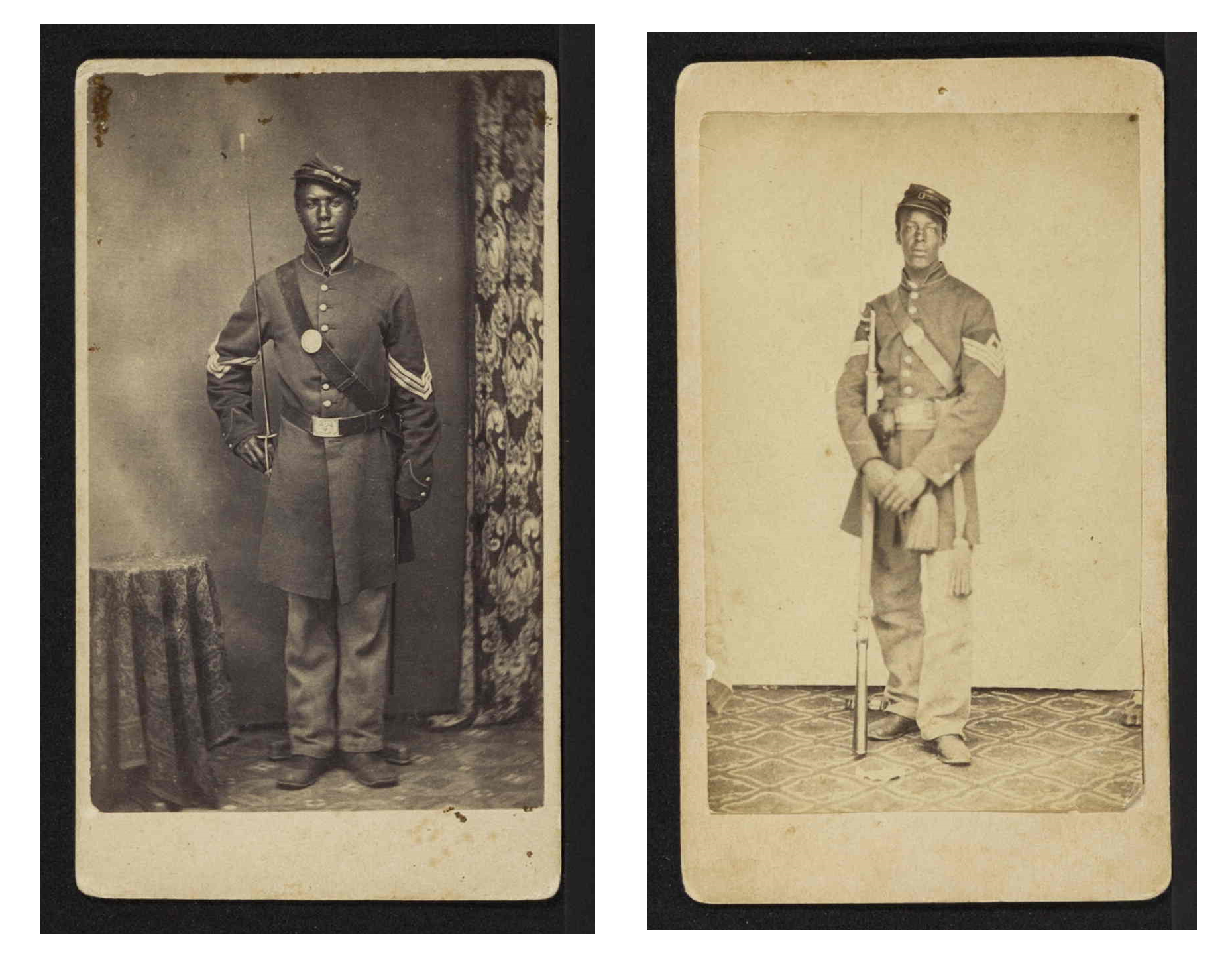
Soldiers of the 54th and 55th Regiments on Display

The five portraits ready for exhibit,
individual images are included below
In honor of Black History Month, we are displaying a selection of carte de visites and tintypes that depict soldiers from the Massachusetts 54th and 55th Volunteer Infantry Regiments in our Collection Spotlight case. As part of the Alfred S. Hartwell Collection, these images serve as important documentation of Black Civil War soldiers. The 54th and 55th Regiments are significant because they were the first two regiments comprised of Black soldiers from the North to serve in the Civil War. A monument commemorating the soldiers of the 54th is located on Beacon Street at the edge of Boston Common, directly across from the State House.

A quick explanation of what these items are, since early photographic formats are not necessarily in use today. Carte de visites are small photographs, similar in size to a formal calling card, that were introduced in the United States in 1859 and rose in popularity during the Civil War. They were traded among friends and sometimes collected in albums. As per their name, tintypes were photographs made on tin that was coated with a dark lacquer or enamel to support the emulsion. They were used for portraiture and were prevalent in the United Stats from the 1860s to the 1870s. They were affordable to produce, which added to their popularity. In total, there are forty-four carte de visites and tintypes in the Hartwell collection, but these five are the only ones that depict Black soldiers.

Three of the five images include some identifying information on the reverse. Pictured below are two carte de visites, the inscriptions on the back identify them as Sergeant Andrew Jackson Smith on the left and Segt. Jackson / 55 Regiment on the right.


An image of “Joe” provides the most information in the inscription. He is identified as “Joe / Headquarters / Camp Meigs / Readville, Mass. / Oct 1862.” Camp Meigs was a training camp used from 1862 through 1865. It is in the Readville neighborhood (part of Hyde Park) of Boston, and the 54th and 55th regiments both trained there.


 The following two images are tintypes and include no identifying information:


On January 26, 1863, Massachusetts governor John Andrew received permission from the U.S. War Department to raise a Black regiment as part of the Union Army. Enlistment began in February, and those who joined became the 54th Massachusetts Volunteer Infantry Regiment. There was not a large enough Black population in Massachusetts to support a full regiment, so recruitment efforts were focused not just in Massachusetts and New England, but also throughout the country and even into Canada and the West Indies. The result was that there were so many volunteers that the 55th Regiment was also formed. The regiments both trained outside of Boston at Camp Meigs (as referenced in the “Joe” inscription) and the 54th departed for the south in late May 1863, with the 55th departing in July 1863. The National Park Service has articles with information about both the 54th and the 55th regiments on their website. 

During the Civil War, Alfred S. Hartwell, who compiled this collection, served as Captain of the 54th Regiment and then as Lieutenant Colonel of the 55th Regiment. Because of his experience with Black regiments, after the war, he spearheaded an investigation into abuses in the recruiting of Black soldiers in the south. The images displayed here are mementos from Hartwell’s time serving with members of the 54th and 55th Regiments, but the collection also includes materials that document his investigation. The collection has been fully digitized and is available in our digital repository. You can also read more about Hartwell in this previous blog post.

Our Collection Spotlight case has features that mitigate the amount of light that exhibited items are exposed to, but due to the sensitive nature of photographs, we are still mindful of the frequency with which they are displayed. Visit us from February 4 through March 4 to take advantage of the rare opportunity to see these images in person.


Elizabeth Roscio
Preservation Librarian
 

Monday, January 6, 2025

Farmer's Almanacs on Display

1793 title page
For the past few years, we've begun the New Year by sharing an historical almanac from our Special Collections holdings in our Collection Spotlight case. This year, we are keeping the tradition going by sharing three volumes of the Farmer's Almanac: 1793-1799, 1800-1809, and 1810-1819. Bound in ten-year increments, these almanacs are the earliest versions of the publication now known as the Old Farmer's Almanac ("Old" was used occasionally in the 1830s, but added permanently in 1848). You may also see older issues with the alternative spelling “almanack.”

The Farmer’s Almanac began publication in 1792 and continues today, which gives it the distinction as the oldest continuously running publication in North America. It was founded by Robert Bailey Thomas, a resident of Grafton, Massachusetts. Thomas was a schoolteacher who studied astronomy as a hobby, and then transitioned to a career as a bookbinder and bookseller and aspired to produce an almanac. He did so with the publication of the Farmer’s Almanac in 1792, and he served as its editor until his death in 1846.

The 1793 almanac is the first edition of the Farmer’s Almanac, and we’re sharing its title page, which indicates that it is “fitted for the town of Boston, but will serve for any of the adjourning States.” This means that the information found within would be applicable to other surrounding states in New England, but there were other almanacs published regionally that would be relevant for other parts of the country. This almanac was published in Boston at the Apollo Press by printers Joseph Belknap and Thomas Hall, who were also the printers of the fairly short-lived newspaper, the American Apollo. The almanac was then sold at the Apollo office, and also by Robert Thomas himself. The title page gives readers an idea of what they’ll find inside, described as “containing, besides the large number of astronomical calculations and farmer’s calendar for every month of the year, as great a variety as are to be found in any other almanac, of new, useful, and entertaining matter.” We have several 18th and 19th century almanacs in our Special Collections holdings, but not all of them include a farmer’s calendar like this one does. For each month, in addition to predicted weather conditions, lunar phases and astronomical calculations, and important historical dates, there is also a notation of tasks that a farmer should be completing at a certain time. For example, January 16 is shown as “cold but pleasant,” January 17 as “Dr. [Benjamin] Franklin born in Boston, 1706,” and January 18 as “low tides” and for all three dates there is the following entry for the farmer’s calendar, “look well to your cattle, and see that they are kept clean.” There was a wealth of knowledge in the almanac to assist farmers throughout the year.

A page of miscellany, showing a new method for making butter,
rules for a long life, and "Anecdote of the Marquis de
Lafayette and an old soldier." 
In addition to the practical information described above, the Farmer’s Almanac also included interesting tidbits. Throughout the years, editions shared “recipes” to cure maladies like pimples, freckles, toothaches, and corns. Cures were not limited to people, as there were also instructions to cure a sore of any kind in horses, or a wound in sheep. But if you tired of reading about medical ailments, there were also biographical entries for historical figures and listings and descriptions of memorable occurrences throughout the years, almost like an abridged history textbook. Almanacs would also include information like locations of circuit courts, the routes of interstate roads, and academic calendars for local universities like Harvard and Dartmouth. And to add a bit of whimsy, in later years of the almanac’s publication, each month also included an illustration and either a few poetry lines that described the month or a few lines of a poem that continued from month-to-month. Also on display, and shown below, is the drawing and festive verse for January 1814, which reads “Wish you a happy new year  friends and neighbors! / I wish you a full purse, full cellars and barns, / I wish you good hearts to enjoy all your labours, / And not to neglect your immortal concerns.” The almanac was a one-stop shop for information of all kinds! 


Listing out everything that is found in almanacs would make for a lengthy blog post, so just a few sections have been mentioned. The best way to discover the variety of published content is to peruse them, and luckily, more and more are available digitally. Some in our collection are available through our digital repository (links included in the blog posts below), and we’re also in the process of conserving and digitizing even more. A selection of Farmer’s Almanacs, including the 1793 edition, can be found in the Internet Archive and HathiTrust.

If you are in the Boston area, be sure to stop by the library from January 7 through February 4 to see a few Farmer’s Almanacs on display, and check out the links below to learn more about the almanacs we’ve displayed in previous years:

Strong’s Almanack from 1796 and 1797 

The New-England Almanack from 1815 and 1818

Peter Parley's Almanac for Old and Young, 1837

Fleet's Pocket Almanack for the year of our Lord 1789: Being the First after Leap Year and the Thirteenth of American Independence

Isaiah Thomas’s New England Almanac from 1797, 1800, and 1812 


Elizabeth Roscio
Preservation Librarian

Monday, December 2, 2024

Detestable Tea! Boston Tea Party Broadside on Display

December 16th marks the 251st anniversary of the Boston Tea Party. Just over two weeks prior to the now famous event, a two-day meeting occurred where residents of Boston and nearby towns met to discuss what to do with a shipment of tea from England that was sitting in Boston Harbor. At the conclusion of those meetings, a broadside was issued with an account of what was discussed and decided. We hold one of those broadsides in our collection, and in honor of the Tea Party’s anniversary, we’re sharing it this month in our Collection Spotlight case.

A shipment of tea from England arrived in Boston Harbor on November 28, 1773 and on November 29 and 30, citizens of Boston and nearby towns gathered at Faneuil Hall to determine the "proper and effectual method to prevent the unloading, receiving, or vending the detestable TEA sent out by the East India Company." When the gathered group became too large, the meeting was moved to Old South Meeting House. For those who could not attend, an account of that meeting was published as a broadside the next day, December 1, 1773. Throughout the written account, the ship holding the tea is referred to as “Captain Hall’s ship,” but this ship is better known by its name, the Dartmouth, which was under the command of Captain James Hall and was one of three ships that brought tea to Boston Harbor, the other two being the Beaver and the Eleanor. In a previous blog post, one of our reference librarians wrote about the significant tax-related events that occurred in the years and months leading up to the Tea Party, along with the actions that followed in the immediate aftermath of this two-day public meeting. 


The linked blog post puts this broadside in historical context, and is an informational complement to the displayed broadside. We encourage you to read through that post, and then click on the image above or download the broadside from our digital repository to read it in its entirety. There are some key individuals and events to note in the broadside, as highlighted below. In addition to the aforementioned Captain Hall of the Dartmouth, others are: 

The Body: the term used to describe the group assembled.

Jonathan Williams, Esquire: named as moderator to help facilitate the meeting.

Francis Rotch: A whaler from New Bedford and part owner of the Dartmouth.

Captain Edward Proctor and Ezekiel Cheever: the Body passed a motion to establish a security night watch over the Dartmouth to prevent it from being unloaded. Capt. Proctor and Cheever were named as Captains of the Watch. The watch consisted of a group of 25 volunteers, who were instructed to raise alarms if anything happened to them or the ships during their watch.  

Mr. Copley: better known by his full name, John Singleton Copley. Copley was a painter who leaned politically neutral; he was friendly with patriots Paul Revere, John Hancock, and Samuel Adams, but his family had Loyalist ties and his father-in-law, Richard Clarke, was one of the consignees of the tea in this shipment in question. Clarke's company, Richard Clarke & Sons, included his sons Jonathan and Isaac. Other tea consignees included Thomas Hutchinson Jr., Benjamin Faneuil, and Joshua Winslow. Because of his relationship with the Clarkes, Copley served as a go-between the two parties during the course of the meeting. In fact, one of the proposals he brought to the assembly was in regard to the consignees' safety:

“A proposal of Mr. Copley was made, that in case he could prevail with the Mess. Clarkes to come into this meeting, the question might now be put, whether they should be treated with civility while in the meeting, though they might be of different sentiments with this body; and their persons be safe until their return to the place from whence they should come – and the question being accordingly put, passed in the affirmative.”

Despite Copley sharing this information with the consignees, ensuring their safety, they declined to attend the meeting. They stated that they believed 

“nothing would be satisfactory (to the Body) short of re-shipping the tea, which was out of their power, they thought it best not to appear, but would renew their proposal of storing the tea, and submitting the same to the inspection of a committee, and that they could go no further, without incurring their own ruin but as they had not been active in introducing the tea they should do nothing to obstruct the people in their procedure with the same.” 

Though the Clarkes did not attend the meeting, Dartmouth’s Captain Hall and owner Francis Rotch did attend when requested, along with the captains and owners of the other ships expected to arrive with tea: for the Eleanor, Captain James Bruce and John Rowe, and for the Beaver, Captain Hezekiah Coffin (like the Dartmouth, the Beaver was owned by the Rotch family). The meeting concluded with the following resolution, and the vote was then printed and sent to seaports within the colonies and to England: 

“if any person or persons shall hereafter import tea from Great-Britain, or if any master or masters of any vessel or vessels in Great-Britain shall take the same on board to be imported to this place, until the said unrighteous Act shall be repeal’d, he or they shall be deem’d by this Body an Enemy to his Country, and we will prevent the landing and sale of the same, and the payment of any duty thereof. And we will effect the return thereof to the place from whence it shall come.” 

The account of this two-day long meeting reflects the intensity of the situation, as well as the complicated nature of trying to figure out what to do with this detestable tea when there were multiple parties deadlocked on how to proceed - the Royal Governor and consignees, the ship owners and captains, and the colonists! Though we know that the story ends with the destruction of the tea in Boston Harbor, the displayed broadside is an important primary source account of the sentiment and actions that lead to that event. Take advantage of the opportunity to see it in person by visiting our reading room from December 3 through January 7. Huzzah! 


Elizabeth Roscio
Preservation Librarian

Monday, November 4, 2024

A Day of Public Thanksgiving and Praise

As the Thanksgiving holiday approaches later this month, we’re displaying an edition of the Old Colony Memorial and Plymouth County Advertiser in our Collection Spotlight case. Printed on October 26, 1822, this newspaper includes a proclamation for an upcoming Day of Thanksgiving that was issued by Governor John Brooks on October 18, 1822. The proclamation establishes Thursday, December 5 as a day of “Public Thanksgiving and Praise” throughout the Commonwealth.

The proclamation is printed on the far-left column of text

Our broadside collection includes a number of proclamations issued by Massachusetts Governors dating from 1779 to 1902, as well as a few more recent proclamations issued by Governor Baker. Broadsides are large single sheet publications, with writing printed only on the front. They were ephemeral in nature, with the purpose of spreading news or advertisements, and were commonly found in use through the 1800s. Thanksgiving Day proclamations would have been printed as broadsides and then sent to town government or religious officials to share with their constituents and parishioners. We’ve previously written about and displayed the 1783 Thanksgiving Day proclamation issued by John Hancock, but we’ve not previously shared a Thanksgiving Day proclamation that was printed in the newspaper. The publishing of the proclamation in local newspapers would have helped to ensure that word of the Day of Thanksgiving would spread throughout the Commonwealth. The version we’ve displayed is from the Old Colony Memorial, a newspaper which began publication the same year as this proclamation, in 1822, and continues today. And it is timely for the season that the newspaper we are sharing is one that was published in Plymouth County.

As stated in the proclamation, this state-issued Day of Thanksgiving and Prayer establishes that, “The people of every religious denomination are requested to assemble in their respective places of public worship on that day, unitedly to express to Almighty God a deep and grateful sense of the manifold favors and blessings, which He has been graciously pleased to vouchsafe to us.” Those who celebrate Thanksgiving today tend to focus on gathering and giving thanks over a large meal, while the purpose of Days of Thanksgiving and Prayer described in 19th-century proclamations like this one focused on parishioners joining together in religious services. Though there are differences in how we celebrate Thanksgiving today verses what is described here (notably, the proclamation ends with the line, "the people are requested to abstain from all labor and recreation incompatible with the religious services of the day" so those of you planning Thanksgiving football games would have been out of luck), the sentiment of expressing gratitude is the same today is it was in 1822, whether it happens in a religious sanctuary, your dining room, or elsewhere. 

The Old Colony Memorial version of the Thanksgiving Day proclamation will be on display in our reading room through December 3, so be sure to visit us to take a look. The proclamation comprises just a few columns of the displayed newspaper pages, so you’ll also get to see other news and advertisements from 1822. Our Special Collections holdings also includes the 1822 broadside version of this proclamation, which can be found here. On your computer or mobile device, it would be easier to read the full text of the proclamation in the broadside version rather than the newspaper version. And while you're there, you can explore the full collection of proclamations in our digital repository. If you'd like to see just the Thanksgiving proclamations, use the search feature (indicated with a magnifying glass) and type in “Thanksgiving” and “Proclamations.”


Elizabeth Roscio
Preservation Librarian

Monday, September 30, 2024

250 Years Ago This Month: The Convening of the Massachusetts Provincial Congress

In September, the Commonwealth kicked off Massachusetts 250, an initiative to commemorate the state's revolutionary history in the lead-up to the country's semi-quincentennial. We are joining in on the celebration by displaying a revolutionary-period broadside that was issued in October 1774 – 250 years ago this month. The broadside was distributed by the Massachusetts Provincial Congress soon after it was established.

To put this broadside in historical context, we need to go a little further back in time and provide an abridged run-down of what was happening in Boston and throughout Massachusetts in 1773 and 1774. The Boston Tea Party occurred on December 16, 1773 and in the months following, British Parliament enacted four acts, knowns as the Intolerable or Coercive Acts, that were meant to punish residents of Massachusetts for the destruction of the tea. The Acts revoked the Massachusetts Charter and with that, changed the nature of the Governor’s Council, the governing body which had previously been elected by assembly and would now be appointed by the King. The Acts also closed the port of Boston, allowed for the quartering of British soldiers, and allowed royal officials who had been accused of crimes to have their trials moved to Great Britain if they felt they could not receive a fair trial in Massachusetts. Throughout 1774, the Intolerable Acts created a heightened sense of tension between the colonists and Great Britain, as colonists felt they had lost their right to self-government. On October 5 through 7, representatives of the now disbanded General Court met in Salem and organized as the Provincial Congress, with John Hancock as its chair, and became the de facto government, with authority to govern the area (including collecting taxes and raising a militia). The Provincial Congress met again in Concord from October 11 through the 14, where they focused on organizing committees to bring order to their cause during this time of revolt and political crisis, and it was during this meeting that Committees of Safety were established. The Provincial Congress met again in Cambridge on October 26, and the broadside in our collection was published following that meeting.

The primary resolution established at the October 26 meeting was to urge towns to establish their militias, the “minutemen” that we so often hear about in Revolutionary history. The text printed on the broadside begins by describing the current state of British troops stationed in Boston, stating “Whereas in Consequence of the present unhappy Disputes between Great-Britain and the Colonies, a formidable Body of Troops with warlike Preparations of every Sort are already arrived at, and others destined for the Metropolis of this Province, and the expressed Design of their being sent is to execute Acts of the British Parliament.” The text goes on to describe a situation where the colonists would not antagonize the British, but as a measure of protecting themselves, that militias throughout Massachusetts should be organized. Militias should ensure that a slate of officers are be appointed and elected, and furthermore, individuals should equip themselves with arms and perfect their military skill to safeguard their “lives, liberties, and properties.” It is noted at the bottom of the broadside that this is “A true Extract from the Minutes” and handwritten on the back of our copy is the town name Rutland, so we know where this broadside was sent after it was issued. You can see a copy of this broadside in our digital repository, and a version with a transcription is available on the Library of Congress’s website

The Provincial Congress continued to meet throughout the fall, during which time they issued a number of grievances against Royal Governor Thomas Gage. They adjourned in December, but convened again as the Second Provincial Congress in February 1775.  

The convening of the Massachusetts Provincial Congress was a pivotal moment in Massachusetts and American history, as colonists established their own governing structure in response to escalating frustrations with the King and  British Parliament. We are thrilled to have a broadside from one of these early meetings as part of our holdings, and we hope that you will mark the 250th anniversary of the first convening of the Massachusetts Provincial Congress by visiting us from October 1 through the 29th to see it on display in our reading room. A number of broadsides from our collection that date to the 1760s-1780s have recently been conserved by the Northeast Document Conservation Center, and we are excited to share more of them as the Commonwealth celebrates Massachusetts 250. To read more about Massachusetts 250 check out their website and Governor Healey’s press release.


Elizabeth Roscio
Preservation Librarian

Tuesday, September 3, 2024

On Display in the State Library - Back to School!

Whether students are excited to begin a new year or are lamenting the end of summer (or maybe a combination of both), September is synonymous with going back to school! At the State Library, we’re marking the start of a new school year by sharing three historical textbooks in our Collection Spotlight case. On display are A Short Introduction to English Grammar (1775), Pestallozzian Primer (1827), and National Spelling Book and Pronouncing Tutor (1828). Technically, these books are primers, which are the early learning books that are used to teach the foundations of reading and writing.

Clockwise from top left: Pestallozzian Primer (1827), National Spelling Book and
Pronouncing Tutor (1828), A Short Introduction to English Grammar (1775)

Massachusetts has played a strong role in the advancement of education and educational resources over the years and is the home of many educational “firsts.” More about the history of education in the Commonwealth can be found in our 2023 online exhibit. One of the “firsts” noted in that exhibit is the 1687 publishing of The New England Primer, which was the first textbook published for children in the colonies. Though we do not have any early printings of this source in our collection, we do have later editions of The New England Primer - it was in production and used in schools all the way into the 1900s!

One of the oldest primers in our collection is A Short Introduction to English Grammar: With Critical Notes, which was published in 1775 in Philadelphia. It was compiled by the Right Reverend Robert Lowth the Lord Bishop of Oxford, who noted an absence in teaching textbooks for grammar and strove to correct that by producing a grammar primer. Originally published in 1762, this text is considered one of the most influential sources on English grammar. It is interesting to note that when it was originally published, it was not intended for children, but within a few years it was adapted to serve as a primer, and it was used in schools through the twentieth-century.

The title page of Pestallozzian Primer, or, First Step in Teaching Children the Art of Reading and Thinking includes the quote, “Teach a child to think, and give him the words by which he may retain and communicate his thoughts, and you will have more than half completed his intellectual education.” This primer was published in Harrisburg, Pennsylvania in 1827 and the lessons follow the work of  Johann Heinrich Pestalozzi (1746-1827), a Swiss education reformer. As stated in the preface, the lessons focus on creating a “habit of thinking and of understanding what is read.” Rather than the straight grammar and spelling lessons found in other primers, this approach encourages the student to think beyond rules. For example, when learning to read and spell the word “apple” the student is also asked questions like, “Where does the apple grow? Name the parts of the apple? How may it taste?” Notice in the picture that the thinking lessons include a notation that reads, "these lessons will very much relieve the fatigue of mere spelling and reading business." We're sure that students enjoyed the break from rote memorization!

Of the three displayed books, only the National Spelling Book and Pronouncing Tutor was published here in Boston, or more specifically, not too far from the State House at 133 Washington Street. It was printed in 1828 and compiled by B.D. Emerson, who was the principal of the Adams Grammar School, also in Boston. According to the title page, the primer is designed for use in schools throughout the United States and follows Walker’s principles of grammar. This refers to the work of lexicographer John Walker (English, 1732 – 1807) who also taught elocution. This primer explains how to pronounce each syllable of certain words (or groups of words), and also provides spelling lessons.

For the past few years, the State Library has marked the beginning of the school year by displaying some historical education resources from our collection. Revisit our 2023 display, where we shared “Rules and Regulations to be observed by the Teachers of the Public Schools in Dorchester” (1810) and “Order of Exercises at the Dedication of the Building and Installation of the Teacher of the High School” (Dorchester, 1852), and our 2022 display, where we shared an 1835 Quincy School Committee circular with advice for teachers and parents as the school year began. Be sure to visit us from September 5 to October 1 to see this year’s display!


Elizabeth Roscio
Preservation Librarian

Monday, August 5, 2024

On Display at the State Library - Hawaiian Language Bible

This month, Hawaii celebrates the 65th anniversary of its statehood. In honor of that occasion, we’re sharing an original copy of the first translation of the Bible in the Hawaiian language in our Collection Spotlight case. Titled “Ka palapala hemolele a Iehova ko kakou akua,” which translates from Hawaiian to English as “The scriptures of Jehovah our God,” this translation was published by the Mission Press in Oahu in 1838-39, and has been part of our collection since 1841. It will be on display in our reading room through August 30.


 Affixed to the inside cover of the Bible is a copy of 1841 Senate Bill No. 47, “Communication And Report Regarding A Bible In The Language Of The Sandwich Islands.” This bill explains that in 1812, the legislature incorporated the American Board of Commissioners for Foreign Missions, which was initially created in 1810 by a group of recent graduates from Williams College in Williamstown, Massachusetts. With a goal of spreading Christianity, missionaries decamped to locations around the globe, including the Hawaiian islands (then referred to as the Sandwich Islands). The first missionaries to arrive in Hawaii were all from Massachusetts, and they departed Boston Harbor in October 1819 and landed on the Hawaiian Island of Kaua‘I in April 1820. You can read more about the fourteen individuals in this group, known as the Pioneer Company, in an article by the Punahou School.

Missionaries believed that an integral aspect of their work spreading Christianity was to have a translation of the Bible completed in the language of the individuals they were converting. Prior to the arrival of the missionaries, Hawaiian was a spoken language, but the missionaries worked to devise a written alphabet. Over the course of a few years, missionaries worked with Hawaiian scholars to development a standardized written language.  The culmination of that work was the Hawaiian language Bible displayed here. When Senate Bill No. 47 was issued on March 4, 1841, it was done on the occasion of the recent receipt of the Hawaiian language Bible from Oahu. The next day, March 5, the Joint Committee on the Library received the Bible into the collection, where it has remained ever since. You can read the bill in its entirety in our digital repository. You can also read more about the development of the written Hawaiian language and early printing in an article on the Historic Hawai‘i Foundation's website, and check out a few previous blog posts where we’ve written more about Hawaii’s history and resources found in the library’s collection.


Elizabeth Roscio
Preservation Librarian

Monday, July 1, 2024

On Display at the State Library

The upcoming July 4th holiday celebrates America’s birthday, the date in 1776 when the Second Continental Congress ratified the Declaration of Independence in Philadelphia. Here in the State Library, we’re marking the occasion by sharing our copy of the Declaration. We have previously written about and displayed a version printed in The New-England Chronical by Edward Powers and Nathaniel Willis, but now we are excited to share our broadside copy, which was printed by Ezekiel Russell in Salem on July 17, 1776. Visit us throughout the month to see it displayed in our reading room.

After the Second Continental Congress signed off on the final wording of the Declaration, the text was sent to Philadelphia printer John Dunlap, who printed two hundred copies as broadsides. The text was then distributed to the thirteen colonies, where it was printed in newspapers and as broadsides. The version authorized and distributed to printers throughout Massachusetts included the following instructions for further dissemination (for ease of reading, in this transcription the “long s” which is printed as an “f” has been written as an “s”):

“In Council, July 17, 1776. Ordered, That the Declaration of Independence be printed; and a Copy sent to the Ministers of each Parish, of every Denomination, within this State; and that they severally be required to read the same to their respective Congregations, as soon as divine Service is ended, in the afternoon, on the first Lord’s-Day after they shall have received it: --- And after such Publication thereof, to deliver the said Declaration to the Clerks of their several Towns, or Districts; who are hereby required to record the same in their respective Town, or District Books, there to remain as a perpetual Memorial thereof.”

Note that the Council approved this order on July 17, 1776 and that it was sent to Massachusetts printers almost a full two weeks after the Declaration was first ratified. Though we all know that news in the colonial period was not instantaneous like it is today, this lag time emphasizes the duration that it would take for news to spread throughout the colonies. Once printers received it, it was then printed in their own newspapers and as broadsides that were sent to ministers to share with their congregants at the next Sunday service, as described above. In Boston, it was also read from the balcony of the Old State House to crowds gathered below on July 18.

The printer of the displayed broadside, Ezekiel Russell, lived in Salem during a portion of the Revolutionary War and was a prolific publisher. In addition to this broadside, he was also the printer of The American Gazette or The Constitutional Journal. Following the instructions from the broadside, Russell was authorized to print the Declaration at his shop and distribute it to ministers throughout the North Shore. Written in iron gall ink on the back of the broadside is the notation “To the Rev. Mr. Holyoke, Boxford” so we know which congregation received this specific version.

In December 2016, this broadside received conservation treatment at the Northeast Document Conservation Center (NEDCC). The broadside was cleaned, tape was removed, and paper tears and losses were filled in with Japanese paper and wheat paste. The result is the beautifully mended and stabilized broadside that we can now safely display. And for those who can’t visit us in person, once the broadside was conserved, NEDCC’s Imaging Services Department provided us with a high-quality digital version which we can share in our digital repository. During the 1700s, broadsides were meant to be printed and distributed quickly to disseminate important information and keeping them intact to save for future generations was not necessarily the objective. We’re lucky to have such a well-preserved version in our collection and hope that you’ll be able to visit us this month to see this inspiring document in person.


By Elizabeth Roscio
Preservation Librarian