Showing posts with label Broadsides. Show all posts

Monday, December 1, 2025

Two Tea Documents on Display

In case you missed it, last December we exhibited a broadside concerning the shipment of tea that arrived in Boston Harbor in November 1773. The question of what to do with this tea culminated in its destruction in the harbor on December 16, a monumental event that we know of as the Boston Tea Party. We're happy to share that the broadside is once again on display this month, along with a companion letter that was issued by the Boston Committee of Correspondence at the same time.

The broadside describes meetings held on November 28, 29, and 30 when residents of Boston and nearby towns gathered to discuss the matter of the tea. Click over to our blog post from last year to read about it in detail.

Serving as a companion to the broadside is the letter issued by the Boston Committee of Correspondence, which serves as a brief cover letter for the broadside. Displaying them together helps us to interpret how news was disseminated throughout the Commonwealth during the Revolutionary Period. Committees of Correspondence were established throughout the thirteen colonies in the 1770s, and the Massachusetts committee got its start in Boston in 1772. Through letter writing, committees formed a network of communication throughout towns in the Commonwealth, as well as between the colonies. Massachusetts’ was headquartered in Boston, and this letter is signed by William Cooper, whose signature appears on many of the 18th century documents in our collection. He served as Boston’s Town Clerk in addition to being a member of Boston's Committee of Correspondence.

As the meetings regarding the shipment of tea were held in Boston, it was the Boston Committee of Correspondence to issue both the displayed broadside and the companion letter. The letter notes that the three-day meeting was moved from Faneuil Hall to Old South Meeting House (a detail also included in the broadside), by writing “On Monday last this and the neighbouring Towns as one Body convened at Faneuil-Hall, ‘till the Assembly were so numerous as occasion’d an Adjournment to the Old South Meeting-House, where it was computed there was upwards of 5000 persons.” Though many individuals attended the meeting in person, the news still needed to be spread throughout the Commonwealth, most pressingly, to provide an account of the matters that were voted upon. As such, an account of the meeting was printed as the broadside, and then it was sent along with the letter to various towns. We are thrilled for the opportunity to display these items together, as intended.

As the Preservation Librarian, I must include a note on the logistics of displaying an item two years in a row. Materials in our Collection Spotlight are only on display for a period of 30 days at a time, as we limit the amount of time that they spend out of dark, climate-controlled storage. The Collection Spotlight case has a microclimate that is conditioned to 68% relative humidity, and its viewing panel is “SmartGlass” which has UV filters and a layer of light-controlling film. When not in use, the glass portion of the case is dark, until it is activated by a button which lights the case for 30 seconds. This allows the case to remain dark for the majority of the time and only illuminated when a visitor wants to view the exhibited item, allowing us to safely display even our most sensitive items on a more frequent basis than if they were in a regular case. While the tea broadside won’t make an appearance every year, the conditions of the Collection Spotlight case ensure that it is safe to display it two years in a row.

Mark the December 16th anniversary of the Boston Tea Party by visiting the library to see these two documents on exhibited together. They are on display from December 2 through January 6. Huzzah!


Elizabeth Roscio
Preservation Librarian

Monday, December 2, 2024

Detestable Tea! Boston Tea Party Broadside on Display

December 16th marks the 251st anniversary of the Boston Tea Party. Just over two weeks prior to the now famous event, a two-day meeting occurred where residents of Boston and nearby towns met to discuss what to do with a shipment of tea from England that was sitting in Boston Harbor. At the conclusion of those meetings, a broadside was issued with an account of what was discussed and decided. We hold one of those broadsides in our collection, and in honor of the Tea Party’s anniversary, we’re sharing it this month in our Collection Spotlight case.

A shipment of tea from England arrived in Boston Harbor on November 28, 1773 and on November 29 and 30, citizens of Boston and nearby towns gathered at Faneuil Hall to determine the "proper and effectual method to prevent the unloading, receiving, or vending the detestable TEA sent out by the East India Company." When the gathered group became too large, the meeting was moved to Old South Meeting House. For those who could not attend, an account of that meeting was published as a broadside the next day, December 1, 1773. Throughout the written account, the ship holding the tea is referred to as “Captain Hall’s ship,” but this ship is better known by its name, the Dartmouth, which was under the command of Captain James Hall and was one of three ships that brought tea to Boston Harbor, the other two being the Beaver and the Eleanor. In a previous blog post, one of our reference librarians wrote about the significant tax-related events that occurred in the years and months leading up to the Tea Party, along with the actions that followed in the immediate aftermath of this two-day public meeting. 


The linked blog post puts this broadside in historical context, and is an informational complement to the displayed broadside. We encourage you to read through that post, and then click on the image above or download the broadside from our digital repository to read it in its entirety. There are some key individuals and events to note in the broadside, as highlighted below. In addition to the aforementioned Captain Hall of the Dartmouth, others are: 

The Body: the term used to describe the group assembled.

Jonathan Williams, Esquire: named as moderator to help facilitate the meeting.

Francis Rotch: A whaler from New Bedford and part owner of the Dartmouth.

Captain Edward Proctor and Ezekiel Cheever: the Body passed a motion to establish a security night watch over the Dartmouth to prevent it from being unloaded. Capt. Proctor and Cheever were named as Captains of the Watch. The watch consisted of a group of 25 volunteers, who were instructed to raise alarms if anything happened to them or the ships during their watch.  

Mr. Copley: better known by his full name, John Singleton Copley. Copley was a painter who leaned politically neutral; he was friendly with patriots Paul Revere, John Hancock, and Samuel Adams, but his family had Loyalist ties and his father-in-law, Richard Clarke, was one of the consignees of the tea in this shipment in question. Clarke's company, Richard Clarke & Sons, included his sons Jonathan and Isaac. Other tea consignees included Thomas Hutchinson Jr., Benjamin Faneuil, and Joshua Winslow. Because of his relationship with the Clarkes, Copley served as a go-between the two parties during the course of the meeting. In fact, one of the proposals he brought to the assembly was in regard to the consignees' safety:

“A proposal of Mr. Copley was made, that in case he could prevail with the Mess. Clarkes to come into this meeting, the question might now be put, whether they should be treated with civility while in the meeting, though they might be of different sentiments with this body; and their persons be safe until their return to the place from whence they should come – and the question being accordingly put, passed in the affirmative.”

Despite Copley sharing this information with the consignees, ensuring their safety, they declined to attend the meeting. They stated that they believed 

“nothing would be satisfactory (to the Body) short of re-shipping the tea, which was out of their power, they thought it best not to appear, but would renew their proposal of storing the tea, and submitting the same to the inspection of a committee, and that they could go no further, without incurring their own ruin but as they had not been active in introducing the tea they should do nothing to obstruct the people in their procedure with the same.” 

Though the Clarkes did not attend the meeting, Dartmouth’s Captain Hall and owner Francis Rotch did attend when requested, along with the captains and owners of the other ships expected to arrive with tea: for the Eleanor, Captain James Bruce and John Rowe, and for the Beaver, Captain Hezekiah Coffin (like the Dartmouth, the Beaver was owned by the Rotch family). The meeting concluded with the following resolution, and the vote was then printed and sent to seaports within the colonies and to England: 

“if any person or persons shall hereafter import tea from Great-Britain, or if any master or masters of any vessel or vessels in Great-Britain shall take the same on board to be imported to this place, until the said unrighteous Act shall be repeal’d, he or they shall be deem’d by this Body an Enemy to his Country, and we will prevent the landing and sale of the same, and the payment of any duty thereof. And we will effect the return thereof to the place from whence it shall come.” 

The account of this two-day long meeting reflects the intensity of the situation, as well as the complicated nature of trying to figure out what to do with this detestable tea when there were multiple parties deadlocked on how to proceed - the Royal Governor and consignees, the ship owners and captains, and the colonists! Though we know that the story ends with the destruction of the tea in Boston Harbor, the displayed broadside is an important primary source account of the sentiment and actions that lead to that event. Take advantage of the opportunity to see it in person by visiting our reading room from December 3 through January 7. Huzzah! 


Elizabeth Roscio
Preservation Librarian

Monday, September 30, 2024

250 Years Ago This Month: The Convening of the Massachusetts Provincial Congress

In September, the Commonwealth kicked off Massachusetts 250, an initiative to commemorate the state's revolutionary history in the lead-up to the country's semi-quincentennial. We are joining in on the celebration by displaying a revolutionary-period broadside that was issued in October 1774 – 250 years ago this month. The broadside was distributed by the Massachusetts Provincial Congress soon after it was established.

To put this broadside in historical context, we need to go a little further back in time and provide an abridged run-down of what was happening in Boston and throughout Massachusetts in 1773 and 1774. The Boston Tea Party occurred on December 16, 1773 and in the months following, British Parliament enacted four acts, knowns as the Intolerable or Coercive Acts, that were meant to punish residents of Massachusetts for the destruction of the tea. The Acts revoked the Massachusetts Charter and with that, changed the nature of the Governor’s Council, the governing body which had previously been elected by assembly and would now be appointed by the King. The Acts also closed the port of Boston, allowed for the quartering of British soldiers, and allowed royal officials who had been accused of crimes to have their trials moved to Great Britain if they felt they could not receive a fair trial in Massachusetts. Throughout 1774, the Intolerable Acts created a heightened sense of tension between the colonists and Great Britain, as colonists felt they had lost their right to self-government. On October 5 through 7, representatives of the now disbanded General Court met in Salem and organized as the Provincial Congress, with John Hancock as its chair, and became the de facto government, with authority to govern the area (including collecting taxes and raising a militia). The Provincial Congress met again in Concord from October 11 through the 14, where they focused on organizing committees to bring order to their cause during this time of revolt and political crisis, and it was during this meeting that Committees of Safety were established. The Provincial Congress met again in Cambridge on October 26, and the broadside in our collection was published following that meeting.

The primary resolution established at the October 26 meeting was to urge towns to establish their militias, the “minutemen” that we so often hear about in Revolutionary history. The text printed on the broadside begins by describing the current state of British troops stationed in Boston, stating “Whereas in Consequence of the present unhappy Disputes between Great-Britain and the Colonies, a formidable Body of Troops with warlike Preparations of every Sort are already arrived at, and others destined for the Metropolis of this Province, and the expressed Design of their being sent is to execute Acts of the British Parliament.” The text goes on to describe a situation where the colonists would not antagonize the British, but as a measure of protecting themselves, that militias throughout Massachusetts should be organized. Militias should ensure that a slate of officers are be appointed and elected, and furthermore, individuals should equip themselves with arms and perfect their military skill to safeguard their “lives, liberties, and properties.” It is noted at the bottom of the broadside that this is “A true Extract from the Minutes” and handwritten on the back of our copy is the town name Rutland, so we know where this broadside was sent after it was issued. You can see a copy of this broadside in our digital repository, and a version with a transcription is available on the Library of Congress’s website

The Provincial Congress continued to meet throughout the fall, during which time they issued a number of grievances against Royal Governor Thomas Gage. They adjourned in December, but convened again as the Second Provincial Congress in February 1775.  

The convening of the Massachusetts Provincial Congress was a pivotal moment in Massachusetts and American history, as colonists established their own governing structure in response to escalating frustrations with the King and  British Parliament. We are thrilled to have a broadside from one of these early meetings as part of our holdings, and we hope that you will mark the 250th anniversary of the first convening of the Massachusetts Provincial Congress by visiting us from October 1 through the 29th to see it on display in our reading room. A number of broadsides from our collection that date to the 1760s-1780s have recently been conserved by the Northeast Document Conservation Center, and we are excited to share more of them as the Commonwealth celebrates Massachusetts 250. To read more about Massachusetts 250 check out their website and Governor Healey’s press release.


Elizabeth Roscio
Preservation Librarian

Monday, July 1, 2024

On Display at the State Library

The upcoming July 4th holiday celebrates America’s birthday, the date in 1776 when the Second Continental Congress ratified the Declaration of Independence in Philadelphia. Here in the State Library, we’re marking the occasion by sharing our copy of the Declaration. We have previously written about and displayed a version printed in The New-England Chronical by Edward Powers and Nathaniel Willis, but now we are excited to share our broadside copy, which was printed by Ezekiel Russell in Salem on July 17, 1776. Visit us throughout the month to see it displayed in our reading room.

After the Second Continental Congress signed off on the final wording of the Declaration, the text was sent to Philadelphia printer John Dunlap, who printed two hundred copies as broadsides. The text was then distributed to the thirteen colonies, where it was printed in newspapers and as broadsides. The version authorized and distributed to printers throughout Massachusetts included the following instructions for further dissemination (for ease of reading, in this transcription the “long s” which is printed as an “f” has been written as an “s”):

“In Council, July 17, 1776. Ordered, That the Declaration of Independence be printed; and a Copy sent to the Ministers of each Parish, of every Denomination, within this State; and that they severally be required to read the same to their respective Congregations, as soon as divine Service is ended, in the afternoon, on the first Lord’s-Day after they shall have received it: --- And after such Publication thereof, to deliver the said Declaration to the Clerks of their several Towns, or Districts; who are hereby required to record the same in their respective Town, or District Books, there to remain as a perpetual Memorial thereof.”

Note that the Council approved this order on July 17, 1776 and that it was sent to Massachusetts printers almost a full two weeks after the Declaration was first ratified. Though we all know that news in the colonial period was not instantaneous like it is today, this lag time emphasizes the duration that it would take for news to spread throughout the colonies. Once printers received it, it was then printed in their own newspapers and as broadsides that were sent to ministers to share with their congregants at the next Sunday service, as described above. In Boston, it was also read from the balcony of the Old State House to crowds gathered below on July 18.

The printer of the displayed broadside, Ezekiel Russell, lived in Salem during a portion of the Revolutionary War and was a prolific publisher. In addition to this broadside, he was also the printer of The American Gazette or The Constitutional Journal. Following the instructions from the broadside, Russell was authorized to print the Declaration at his shop and distribute it to ministers throughout the North Shore. Written in iron gall ink on the back of the broadside is the notation “To the Rev. Mr. Holyoke, Boxford” so we know which congregation received this specific version.

In December 2016, this broadside received conservation treatment at the Northeast Document Conservation Center (NEDCC). The broadside was cleaned, tape was removed, and paper tears and losses were filled in with Japanese paper and wheat paste. The result is the beautifully mended and stabilized broadside that we can now safely display. And for those who can’t visit us in person, once the broadside was conserved, NEDCC’s Imaging Services Department provided us with a high-quality digital version which we can share in our digital repository. During the 1700s, broadsides were meant to be printed and distributed quickly to disseminate important information and keeping them intact to save for future generations was not necessarily the objective. We’re lucky to have such a well-preserved version in our collection and hope that you’ll be able to visit us this month to see this inspiring document in person.


By Elizabeth Roscio
Preservation Librarian

Tuesday, September 5, 2023

On Display in the State Library

From kindergarten to college, students in the Commonwealth are heading back to school! With that in mind, this month we're sharing two circulars associated with public schools in Dorchester in the 1800s – visit us to see “Rules and Regulations to be observed by the Teachers of the Public Schools in Dorchester” (1810) and “Order of Exercises at the Dedication of the Building and Installation of the Teacher of the High School” (Dorchester, 1852).

Dorchester was annexed into Boston in 1870, but when these two circulars were issued it was a separate town that had been founded in 1630. Its educational history dates to that period, too – the Mather School, which is the oldest public elementary school in North America, was established in Dorchester in 1639. The school was named after Richard Mather, a Congregational minister who had emigrated to Dorchester from England in 1635. The original Mather School was a one-room schoolhouse, and though the building has changed over the years, the Mather School is still in existence as an elementary school serving students in grades K through 5.

171 years after the founding of the Mather School, the displayed circular (above) was issued to teachers in Dorchester’s public schools. The notice is divided into ten rules or guidelines, with a notation that it was “first passed on August 26, 1805; with amendments and additions, June 27, 1810.” The regulations include instruction to begin the day with a devotional, which books are recommended for each grade, the school schedule, relationship between the School Master and School Committee, and how to assess if children are ready for school, as follows:

Children are not to be admitted to the Schools, till, they are able to stand up, and read words of two syllables, and keep their places."

On the back of the circular is a handwritten notation of “Mr. Lemuel Crane” and “5 School District,” who we assume was recipient of this notice. A brief search of Lemuel Crane revealed an entry in the Hyde Park Historical Register on the Butler School, which was founded in 1786 and listed a Lemuel Crane as assisting with the endeavor. Since Hyde Park was part of Dorchester at the time, we can speculate that this was the same Lemuel Crane who received the public school circular. The article went on to say that Lemuel Crane also served as a Representative for the 5th District in the General Court. You can read the full article on the Hyde Park Historical Society’s website (pages 9-12).

Jumping forward in time, we are also displaying a circular from the dedication of Dorchester High School, which occurred on December 7, 1852. The program for the dedication was as follows: remarks from the Chairman of the Building Committee, a reply and address by the Chairman of the School Committee, a prayer, a hymn sung by the pupils, an address to the pupils, a poem, another hymn sung by the pupils, and finally an introduction of the teacher followed by remarks from the teacher. That sounds like a long program, so we hope that there were also some refreshments on hand for the attendees! Take a close look at the image to see the content of the two hymns.

Last year, we marked the beginning of the school year by displaying the rules and regulations for Quincy Public Schools, published in 1835. You can read about that circular, and the textbooks that were displayed alongside it, here. And be sure to visit us through September 28 to see these Dorchester circulars on display in our main reading room. Happy back to school!


Elizabeth Roscio
Preservation Librarian

Monday, May 1, 2023

Preservation Week at the State Library: A Conserved Item on Display!

Happy Preservation Week! April 30 through May 6 has been designated by the American Library Association as time to raise awareness of the preservation measures that are taken in libraries, archives, and museums to ensure the long-term integrity of their collections. Here at the State Library, our preservation program covers book and paper repair, reformatting, environmental monitoring and disaster preparedness, and re-housing and cleaning our collection. The physical repair of items in our collection is called conservation, and while we undertake a fair amount of that work on-site in our preservation lab, we also occasionally send out items to be treated at the Northeast Document Conservation Center (NEDCC). This month, we are celebrating Preservation Week by exhibiting an item in our display case that has undergone treatment at NEDCC, along with a facsimile of it in its “before” state. Displaying these items side-by-side really emphasizes the transformation that an item undergoes when it’s conserved!

The displayed broadside is An Act to Prevent Profane Cursing and Swearing, published by the Commonwealth of Massachusetts in 1798. It was part of an NEDCC project in 2017/2018 to conserve some of the historically significant broadsides in our Special Collections holdings. When we work with NEDCC, they begin by sending us a condition assessment and proposed treatment plan. Once the item has been conserved, we receive before/after images, along with a detailed description of the item’s condition upon receipt and subsequent treatment. Having thorough documentation of condition and treatment allows us to maintain a comprehensive record of the items in our collection. In this instance, the broadside had tape and residual adhesive removed, it was humidified and cleaned, and tears were mended with toned Japanese paper. Then the back of the page was lined with Japanese paper and wheat starch paste, making it safer for handling. The result is a cleaner and sturdier broadside that looks almost as good as it would have back when it was first printed in the 18th century!

And now a note on the content of item that so much work went into to conserve! This broadside was issued in June 1798 after an act was passed by the Senate and the House of Representatives that states, “if any person, who has arrived at discretion, shall profanely curse or swear, and shall be therefore convicted, such person so offending, shall forfeit and pay a sum not exceeding two dollars, nor less than one dollar, according to the aggravation of the offense.” The act went on to state that if swearing occurred in the presence of any Sherriff, Deputy Sherriff, Coroner, Constable, Grand Juror, or Tythingman, then they should report the act to the Justice of the Peace so that the offender could be convicted and punished. Broadsides such as this were then sent to Town Clerks throughout the Commonwealth to be read aloud at town meetings, and they were also sent to public teachers of religion (or pastors) to be read to their congregations annually. So in sum, if you wanted to avoid paying a fee in the Commonwealth in the late 1700s, you better not swear in the presence of any public official!  And while seemingly not enforced, blasphemy is still on the books of Massachusetts law! 

If you have an item in your personal collection that needs professional conservation treatment, you can find a list of local conservators through the American Institute for Conservation directory. But much of the information shared by organizations during Preservation Week can be applied to your collection on your own. We will be posting preservation content on our social media channels every day this week, so we hope that you will follow along as we celebrate all things preservation! And if you are in the area, be sure to visit us through May 30 to see our conserved broadside on display in our reading room.


Elizabeth Roscio
Preservation Librarian

Monday, April 3, 2023

On Display at the State Library

This month, we’re sharing a 19th century broadside from our collection that pertains to track work and commuting to and from Boston - a topic that continues to dominate local news today! Commuters taking the Massachusetts Bay Transportation Authority (MBTA) in and out of the city are currently experiencing a slower ride because of “slow zones” and track inspections on most of its lines. In track news of a different sort, in 1888, residents in Quincy were notified that they might soon find it easier to get into the city - the item we’re sharing is a notice that was issued calling for a Quincy town meeting to hear proposals for the laying of tracks and use of motive power of the Quincy and Boston Street Railway Company. 

Much like how the MBTA currently holds public meetings, on January 17, 1888 a notice was issued by the Selectmen of Quincy to inform the general public of an upcoming town hall meeting to discuss the petition of the Quincy and Boston Street Railway Company for the construction of a track from Neponset Bridge to the intersection of Hancock and Squantum Streets. At the town meeting, they were also scheduled to hear about the petition of the Quincy and Boston Street Railway Company to use motive power (i.e. powered by water or steam) on its tracks as authorized by the General Laws of the Commonwealth. Readers familiar with Quincy will recognize many of the street names listed on the notice: Hancock Street, Granite Street, and Willard Street, to name a few. 

But does this proposed track relate at all to the current MBTA track? The short answer is yes, the Quincy and Boston Street Railway Company is an early relative of today’s MBTA. In 1900, it was sold to the Brockton Street Railway Company, whose name was changed to the Old Colony Street Railway Company in 1901 - this is not to be confused with the Old Colony Railroad, which was a major railroad system in southeastern Massachusetts and Rhode Island. The Old Colony Street Railway Company then merged with the Boston and Northern Street Railway Company and formed the Bay State Street Railway Company, which operated in Boston and as far north as New Hampshire and as far south as Rhode Island. In 1919, Bay State was absorbed into the Eastern Massachusetts Street Railway, which was then acquired by the MBTA in 1968. In the eighty years that passed from the issuance of this notice to the MBTA acquisition, these tracks changed ownership a number of times. 

Visit us through April 25 to see this notice on display in our main reading room. And if you attend a public MBTA meeting now, you can rest assured in the knowledge the Boston area residents have been contending with public transportation for quite some time! You can also keep up to date on all things MBTA by checking out the resources in our digital repository. Here you’ll find copies of annual reports, “week in reviews and lookaheads” for each subway line, and more.  


Elizabeth Roscio
Preservation Librarian

Monday, November 7, 2022

On Display in the State Library

Election Day is tomorrow, November 8! With that occasion in mind, this month's displayed item is a
broadside of a resolution passed by the Massachusetts State Senate on November 19, 1788 stating that the Commonwealth would be divided into eight districts “for the purpose of choosing eight persons to represent the people thereof in the Congress of the United States.” The resolution further stated that selectmen should call town meetings on December 18 so that those qualified to vote should gather to cast their ballot for their respective representative.  The broadside in our collection was sent to the selectmen in the town of Manchester.

The Massachusetts state legislature was formed and a state Constitution ratified in 1780, but it would be nearly a decade later that the early republic would ratify the United States Constitution, form the federal government, and elect officials. The eight individuals elected from the districts announced in this resolution would serve in the very first session of the United States House of Representatives. 

The eight districts in the resolution are as follows:

  • The County of Suffolk, be one district
  • The County of Essex, one district
  • The Count of Middlesex, one district
  • The Counties of Hampshire and Berkshire, one district
  • The Counties of Plymouth and Barnstable, one district
  • The Counties of York, Cumberland and Lincoln, one district
  • The Counties of Bristol, Duke’s County and Nantucket, one district
  • The County of Worcester, one district

This looks different from today’s Congressional districts - there are currently nine districts, and they aren’t cleanly divided by county (for example, cities/towns from Worcester County can be found in five different Congressional districts). Also of note is the district that included the counties of York, Cumberland, and Lincoln - you may not recognize those as Massachusetts counties because they are in Maine! It wasn’t until 1820 that Maine was granted its statehood and separated from Massachusetts.

The voting process was also different in 1788 than it is today. This resolution instructs town selectmen to call for those eligible to vote to gather on December 18 to vote for a representative from their town. Specific candidates were not listed on a ballot – basically everyone was a write-in candidate. The town selectmen shall then “sort and count the votes, and form a list of the persons voted for, with the number of votes for each person.” Those results were announced at the town meeting and then the tabulation of votes for that town were sealed and sent to the Secretary of the Commonwealth, with a submission deadline of the first Monday of January 1789. The Secretary would then present all the town votes to the governor, who at the time was John Hancock, and the Governor’s Council. Several towns made up each district, so whichever candidate received the most votes within each district would receive a certificate from the governor announcing their election. If there was not a majority within a district, then the governor would issue a certificate with the names of the two individuals who received the highest number of votes to all of the towns within the district. The selectmen in those towns would then call a second town meeting for those eligible to vote to decide between those two candidates. As it turned out, of the eight districts, four of them did not have a majority in the first vote and went on to hold a second. More information about this election can be found in A Documentary History of the First Federal Elections, 1788-1790

This resolution was issued during a formative time in American history, as members of Congress were elected for the first time, and just before George Washington was elected as the first president. But it’s important to note that in many states it was only white landowning men who were eligible to vote. When you head to the polls this week, think about the changes and expansions that have occurred in the 234 years that have ensued since this resolution was issued, and if you’re in the area stop by through November 30 to see it on display in our main library reading room.


Elizabeth Roscio
Preservation Librarian

Monday, October 3, 2022

On Display in the State Library

This month, we’re displaying a broadside of a proclamation that was issued on August 29, 1780 and called for a special session of the Great and General Court or Assembly of the state of Massachusetts-Bay to convene on September 8, 1780. The General Court had been prorogued (or deferred) from July until September 13 but were called back to an earlier session because, as stated in the proclamation, “such intelligence has been received, and of such an important nature, as renders necessary that the said Court should be called together sooner than the time to which it stands prorogued.” 

There was a lot going on in Massachusetts in the fall of 1780. While the Revolutionary War continued on, Massachusetts was in the final stages of establishing its constitution. In 1779, town delegates participated in a constitutional convention, which resulted in a draft written by John Adams. The Massachusetts Constitution was ratified in June of 1780 and became effective on October 25. When this proclamation was issued on August 29, the state was less than two months away from having its constitution in place. Once the constitution was effective, John Hancock was elected the first Governor of Massachusetts, and the legislative branch was formally established with a House of Representatives and Senate – 242 years ago this month!

A quick way to identify this proclamation as dating to prior to the establishment of the state constitution is that it addresses the “Great and General Court,” terminology that was changed to the Massachusetts General Court after October 25, 1780. The General Court was and is the name given to Massachusetts state legislature – with the Senate as the upper house and the House of Representatives as the lower body. But the colonial legislature in place prior to the establishment of the constitution can be a little confusing, so an abridged version follows. The Province of Massachusetts Bay had a royal governor until 1775, the last of which was Thomas Gage, who was recalled amid the rising tensions of the Revolutionary War. From that point until 1780, Massachusetts was run by a Provincial Congress, without a governor or lieutenant governor in office. This proclamation falls at the very end of that political period. It refers to the Great and General court, or Assembly, which would be the equivalent of the lower house. But it is also important to note that the proclamation was issued on order of the Council, which was a group of individuals who were elected from the General Court and served as executives in the absence of a governor. If you look closely at the proclamation, you can see that it was issued in the Council Chamber of what is now known of as the Old State House, but in 1780 it was the seat of state government, housing the Council Chamber, the Supreme Judicial Court, and the space where the Assembly met. 

And now a note on the condition of this item, since it needed a bit of preservation attention before it was ready for display. We could tell by looking at it that there were lost fibers in the bottom portion, making it thinner and a bit fragile. As such, it had previously been stabilized by housing it between two pieces of archivally sound plastic sheets that were held together with double-sided tape. Though it was securely in place, we remove this type of enclosure because if the item shifts at all, it runs the risk of coming in contact with the tape. Before going on display, it was removed from the old enclosure and once it is off of display, we will make a new enclosure for it using Mylar sheets and our encapsulator, which makes a seal using heat rather than adhesive. Once it was out of its plastic enclosure, we were able to determine that there was a fair amount of dirt on the bottom portion. Since it was weak in that spot, we very gently cleaned it without causing any tears. In the image to the left, the “before” is on the top and the “after” is on the bottom.

With a little bit of care, this 242-year-old document was ready for display! Visit us throughout the month of October to see it on display in our main reading room.


Elizabeth Roscio
Preservation Librarian

Monday, August 29, 2022

On Display in the State Library

It’s time to head back to school! For our display this month, we’re featuring a circular distributed by the Quincy School Committee in 1835 with advice for both teachers and parents. And referenced at the bottom of the circular are a few of the textbooks that the students will be using during the school year – some of which we have in our Special Collections holdings!

The Quincy School Committee issued this circular on September 1, 1835 with the full title of “Rules and regulations for the public schools in Quincy: also, some remarks on the due observance of the rules, addressed to parents.” On the webpage for the current Quincy School Committee, their mission reads as “the purpose of the School Committee is to establish policies and make decisions on the basis of educational philosophy and goals, the most crucial of these being facilitating the optimal learning experience of the children enrolled in the Quincy Public Schools.” Comparing that with the text of this circular shows that the purpose remains relatively unchanged 187 years later.

The section for teachers covers five points, some of which fall into generalities like start and end times to the day, absences, and tardiness. The fourth point is the most lengthy, and addresses student conduct. In this section, teachers are tasked with trying to keep their students in line, with instructions as follows, “You are also requested to prevent their throwing stones or any other hard substances at each other, or into any of the enclosures about the premises you occupy . . . Allow no quarreling among the scholars at any time - nor any vulgar or profane language . . . Impress upon their minds the importance of correct manners and habits; inspire in them a strict regard for truth, honesty and amiable deportment . . .”

The list goes on! But regulations and suggestions were extended to parents and guardians, too. That section begins by informing them that success in school is dependent on the guardian's cooperation with the teacher. It also includes the following, with printed emphasis, to stress the role that teachers play “You, undoubtedly, have your patience tried with your own children, though you may have but a half dozen under your care, while the teacher has from fifty to a hundred or more perhaps: – You have only to govern them – the teacher has to govern the multitude, and advance them in their studies at the same time – You are accountable to no human power for your management – he is responsible to numberless parents and the public generally.” The circular really lays down the law for guardians, and stresses the importance of education by including that “to get an education is a great object of childhood.” Click on the above image to read the circular in full.

According to the circular, at meetings on May 7th and August 31st, the committee voted on the textbooks that would be used for the school year. We were lucky to find that some of those  are part of our collection. Accompanying the circular on display are The National Spelling-Book and Pronouncing Tutor, published in 1828, and First-Class Reader: a Selection for Exercises in Reading, published in 1834. Both books are by Benjamin Dudley Emerson, who was the principal of the Adams Grammar School in Boston, and published textbooks on spelling, reading, and arithmetic, which were widely used in schools in the 1800s.

The committee voted that a copy of the circular should be printed and a copy sent to every family in the town. On the back of our copy is a handwritten notation dated September 1835 that reads “to the School Committee, Dorchester” so it’s possible that the circular was sent to other local school committees to serve as a reference. A stamp on the back indicates that the State Library received it as a gift on August 25, 1936, though a search of the 1936 annual report did not provide any additional information about the gift.

If you’d like to mark the beginning of the 2022-2023 school year by checking out some school resources and textbooks from the 1830s, then be sure to visit us from September 1 through October 3 to see these items in person!


Elizabeth Roscio
Preservation Librarian

Monday, August 1, 2022

On Display in the State Library

You’d be hard-pressed to read the real estate pages in any major area newspaper right now and not
see something about how hard it is to buy a house! With that theme in mind, we selected an item for our August display that speaks to the housing market in 1847. Visit us this month to see “Sale of valuable house lots in South Woburn: near the railroad” - a broadside that was published in Boston by Eastburn’s Press. 

This broadside encouraged potential homebuyers to attend a land auction held in South Woburn on Thursday, May 27, 1847. And though it was written 175 years ago, the text of the broadside reads much the same as property listings today. It boasts that the lots for sale are within a three-minute walk of the train depot, with trains to and from Boston stopping at the station 18 times per day, as well as nearby churches, good schools, and a thriving village. Who wouldn’t want to live near all of these amenities! The lots were good-sized, too, ranging from 6,000 to 15,000 feet and located near Wedge Pond. There was a second auction held earlier in the day for a “modern two-story house and lot of land” - for those who don’t want to construct their own home. Unfortunately, we don’t know the results of this auction, though it would be interesting to see how much the land sold for! 

Next, we tried to find this area on a map and used the reference to Wedge Pond as our guide. On modern maps, this area is identified as part of Winchester rather than Woburn. A search on Winchester’s history led us to the Winchester Historical Society where we learned that “the thriving village [Winchester] soon began to feel the need to separate from the parent town of Woburn, and it was the South Woburn Congregational Church that initiated the move. In 1840 the South Woburn Congregational Church provided the first house of worship within the village boundaries. By 1850, the town was ready to establish its independence from Woburn.” This land auction dates to three years prior to the incorporation, so the plots eventually became part of the town of Winchester, not Woburn. We would guess that the area looks much different today than it did in 1847, but you can get a sense of what it looked like by viewing this bird’s-eye view map of Winchester from 1886, found in the collection of the Norman Leventhal Map Center

And returning to the broadside, we noted that the auction was led by N.A. Thompson, whose office is listed as in the Old State House. But why would an auctioneer have an office in a historic structure that is part of the Freedom Trail? That’s because the 1713 structure has served a number of purposes over the years! It was the seat of colonial and state government before the construction of the State House (and our home) on Beacon Hill, and then it served as Boston City Hall. But at the time of this auction, the Old State House was rented out for commercial use! From 1841 until 1881, various merchants had their offices in the building - including N.A. Thompson, who occupied space until at least the late 1860s. Pictured is an image from our collection of the Old State House in 1858, with business placards affixed to its exterior. 

We hope that you’ll have the opportunity to visit us this month to see this broadside on display in our main reading room. Click here to see a higher resolution version in DSpace.


Elizabeth Roscio
Preservation Librarian

Tuesday, July 5, 2022

On Display at the State Library

This July, we’re excited to exhibit a true treasure from our collection, and an integral part of American history. Visit our main reading room throughout the month to see a copy of the Declaration of Independence that was printed for The New-England Chronicle by Edward E. Powers and Nathaniel Willis on July 18, 1776.  

But if the Declaration of Independence signed by delegates of the Second Continental Congress in Philadelphia on July 4th, then why was it printed in Boston on July 18th – almost two full weeks later? That’s because Bostonians did not hear the stirring words of the Declaration until it was read from the balcony of the Old State House on July 18. And for those who were not part of that large crowd, it was also published in Boston on the same date. Three Boston newspaper publishers--John Gill, Edward E. Powars, and Nathaniel Willis--came together to print the Declaration as a broadside and in newspapers. Similar to modern-day posters, the broadside was a large piece of paper with printing just on one side that was posted and shared throughout the city. To ensure that the news of the Declaration spread even farther, its text was printed in Gill’s Continental Journal and Powars and Willis’ The New-England Chronicle, the copy of which we have in our Special Collections holdings. These are the only two newspapers in Boston that published the Declaration of Independence, though it appeared throughout Massachusetts in newspapers in Newburyport, Watertown, Worcester, and Salem. 

In a previous blog post, we wrote more in-depth about this item. Click here to read more about how the Declaration text traveled from Philadelphia to Boston, an interesting fact about all of the “f”s that make their way into colonial printing, and a note on the items’ condition. 

This July, celebrate America’s birthday by visiting us for the rare opportunity to see a 1776 version of the Declaration of Independence in person! 


Elizabeth Roscio
Preservation Librarian

Monday, January 31, 2022

On (Virtual) Display in the State Library

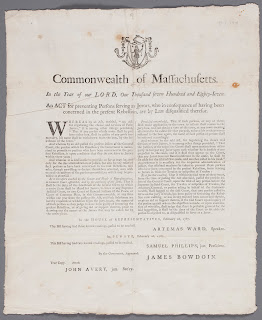
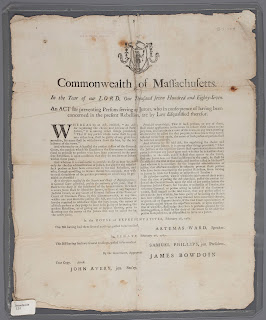
This month, our featured collection item is a broadside dating to February 1787 and issued by the Massachusetts General Court while James Bowdoin was governor. Titled in part as “An Act for Preventing Persons Serving as Jurors, Who in Consequence of Having Been Concerned in the Present Rebellion, Are by Law Disqualified Therefor,” the broadside addresses some consequences for those who participated in Shays’ Rebellion, which concluded earlier in the month that this Act was passed. 

James Bowdoin was elected as governor in May 1785, following John Hancock’s resignation partway through his term. Once in office, Bowdoin worked to collect back taxes, which Hancock had been reluctant to actively pursue while governor. But in a depressed post-Revolutionary War economy, Bowdoin made it a priority to both raise taxes and collect back taxes in an effort to raise funds for the state’s portion of foreign debt payments to European war investors. This was met by protest from those in the central and western parts of the state who were struggling financially since they had not been paid for their wartime service. Individuals now found themselves having to pay high taxes that they could not afford, or risk losing their livelihood, a situation that caused unrest and ultimately led to what we now know of as Shays’ Rebellion. 

This month marks 235 years since the conclusion of Shays’ Rebellion, which was an armed uprising that occurred in western Massachusetts beginning in the summer of 1786. Residents of the area organized protests in response to the fact that the legislature had adjourned without addressing their concerns about taxation. From August to October, groups of protesters successfully forced the closure of courts in Northampton, Worcester, Great Barrington, Concord, and Taunton. In January 1787, led in part by Daniel Shays, groups of protesters organized in an attempt to overtake an armory in Springfield. They were met by a militia organized by Gov. Bowdoin, which consisted primarily of individuals from the eastern part of the state. Clashes continued from the end of January into early February, before the protesters’ forces fell apart and many participants fled north.

The broadside in our collection was Issued by the General Court in the weeks after Shays’ Rebellion. The Act printed on it stated that anyone who favored the rebellion, or gave aid or support to the rebellion, was prohibited from serving as a juror for three years. Selectmen from the towns in which the participants resided were instructed to remove their names from the jury-boxes (from which names would be drawn to serve as jurors). Earlier in February, the legislature also passed the Disqualification Act, which disqualified any known participant in the rebellion to serve in some elected or appointed positions. There is a lot more to the economic climate leading to Shays’ Rebellion, the rebellion itself, and its aftermath than we can address in this blog post. To learn more, check your local library for books like  Shays's Rebellion: Authority and Distress in Post-Revolutionary America by Sean Condon and Shay’s Rebellion: The American Revolution's Final Battle by Leonard L. Richards.

And lastly, a note on the condition of this broadside, since it looks pretty good for having been printed 235 years ago! We do a lot of collection repair and preservation work in-house, but we send items out to the Northeast Document Conservation Center (NEDCC) for more involved work. In 2018, this broadside was one of a few that underwent treatment at NEDCC. It was removed from its plastic enclosure and then cleaned to reduce staining, discoloration, and acidity. It was also humidified so the edges could be uncurled and creases reduced, and then any tears and losses were mended with thin Japanese paper and wheat starch. Check out the image to the right to see how it looked before treatment and compare that with the “after” photo featured at the beginning of this post! 

Elizabeth Roscio
Preservation Librarian