Happy October from the State Library! Pictured here is a preview, but the full issue can be accessed by clicking here. And you can also sign up for our mailing list to receive the newsletter straight to your inbox.

Happy October from the State Library! Pictured here is a preview, but the full issue can be accessed by clicking here. And you can also sign up for our mailing list to receive the newsletter straight to your inbox.


There was a lot going on in Massachusetts in the fall of 1780. While the Revolutionary War continued on, Massachusetts was in the final stages of establishing its constitution. In 1779, town delegates participated in a constitutional convention, which resulted in a draft written by John Adams. The Massachusetts Constitution was ratified in June of 1780 and became effective on October 25. When this proclamation was issued on August 29, the state was less than two months away from having its constitution in place. Once the constitution was effective, John Hancock was elected the first Governor of Massachusetts, and the legislative branch was formally established with a House of Representatives and Senate – 242 years ago this month!
A quick way to identify this proclamation as dating to prior to the establishment of the state constitution is that it addresses the “Great and General Court,” terminology that was changed to the Massachusetts General Court after October 25, 1780. The General Court was and is the name given to Massachusetts state legislature – with the Senate as the upper house and the House of Representatives as the lower body. But the colonial legislature in place prior to the establishment of the constitution can be a little confusing, so an abridged version follows. The Province of Massachusetts Bay had a royal governor until 1775, the last of which was Thomas Gage, who was recalled amid the rising tensions of the Revolutionary War. From that point until 1780, Massachusetts was run by a Provincial Congress, without a governor or lieutenant governor in office. This proclamation falls at the very end of that political period. It refers to the Great and General court, or Assembly, which would be the equivalent of the lower house. But it is also important to note that the proclamation was issued on order of the Council, which was a group of individuals who were elected from the General Court and served as executives in the absence of a governor. If you look closely at the proclamation, you can see that it was issued in the Council Chamber of what is now known of as the Old State House, but in 1780 it was the seat of state government, housing the Council Chamber, the Supreme Judicial Court, and the space where the Assembly met.

With a little bit of care, this 242-year-old document was ready for display! Visit us throughout the month of October to see it on display in our main reading room.
Elizabeth Roscio
Preservation Librarian
On October 31, 1938, the Boston Globe donated a collection of forty-four original photographs of World War I soldiers to the State Library of Massachusetts. Consisting primarily of members of the 101st, 104th, 301st, and 302nd Infantries of the 26th (“Yankee”) Division, this collection depicts groups of soldiers at military training camps, most often Camp Devens in Ayer, Massachusetts, and Camp Darling in Framingham, Massachusetts.
 |
| Co. D, 6th Regt., Mass. Infantry, Camp Devens, 1917 |
Although most of the photographs lack annotation, some do include a list of the soldiers’ names and addresses on the back, which might be of particular interest to genealogists. For example, several photos of soldiers from the 104th Regiment include handwritten names and addresses from Massachusetts cities such as Salem, Peabody, Beverly, and Quincy, as shown below.


This recently digitized collection is complemented by another large photograph collection: individual portraits of WWI “Yankee Division” soldiers, which were also donated to the State Library by the Boston Globe. You may view that collection in our online repository and read all about it in a previous blog post from the State Library.
If you have any questions about either of these WWI photograph collections, please don’t hesitate to reach out to our Special Collections Department, either by phone at 617-727-2595 or by emailing us at Special.Collections@mass.gov. And keep an eye on our online repository, as we are adding new publications and collections each weekday.
Laura Schaub
Cataloging Librarian

In general, roll call votes, or voting by “yeas” and “nays,” is a method in which the clerk or presiding officer calls each member’s name and their answer of yea or nay is recorded. In Massachusetts, legislators have the option of voting Yea (Y), Nay (N), Present (P), or Not Voting (X). An asterisk (*) next to a member’s name denotes that the vote was made after the roll call was taken.
 |
| Example of House Roll Call from Yea/Nay Supplement; Note Roll Call No. 184. |
Some bills and specific legislation in Massachusetts require roll call votes as determined by the state’s Constitution. For example, bills authorizing the Commonwealth to borrow or lend money or for land taking require roll call votes. For more information, see the Massachusetts Legislative Research and Drafting Manual.
If you are researching a bill, and want to know whether a roll call vote occurred, you can check the bill’s history either in the journals or online. For the House, roll call votes are organized into the Yea/Nay Supplement of the journals. Each roll call vote is assigned an identifying number. In the print House journals, the supplement can be found at the end of the last volume. Researchers can also download roll call votes as PDFs using the specific roll call number or can download all roll call votes for a given year from the Massachusetts Legislature Site. For the Senate, roll call votes are included in the journals on the day in which the vote was taken; Senate roll calls are also numbered separately.
Another helpful resource to consult is the Massachusetts Political Almanac. The almanac compiles key Senate and House Roll Call votes from the yearly legislative session. It provides a summary of the bill as well as the outcome of the vote. The library holds print issues of the Massachusetts Almanac back to 1974.
As the almanac notes, while it is beneficial to know how your legislator voted on a certain cause or bill, a simple “yea” or “nay” cannot encompass all motivations or reasoning behind a vote. That’s why it is encouraged to contact your legislator’s office to learn more about each issue.
For assistance on any of the resources mentioned, please contact the Reference Department at reference.department@mass.gov
April Pascucci
Reference Librarian
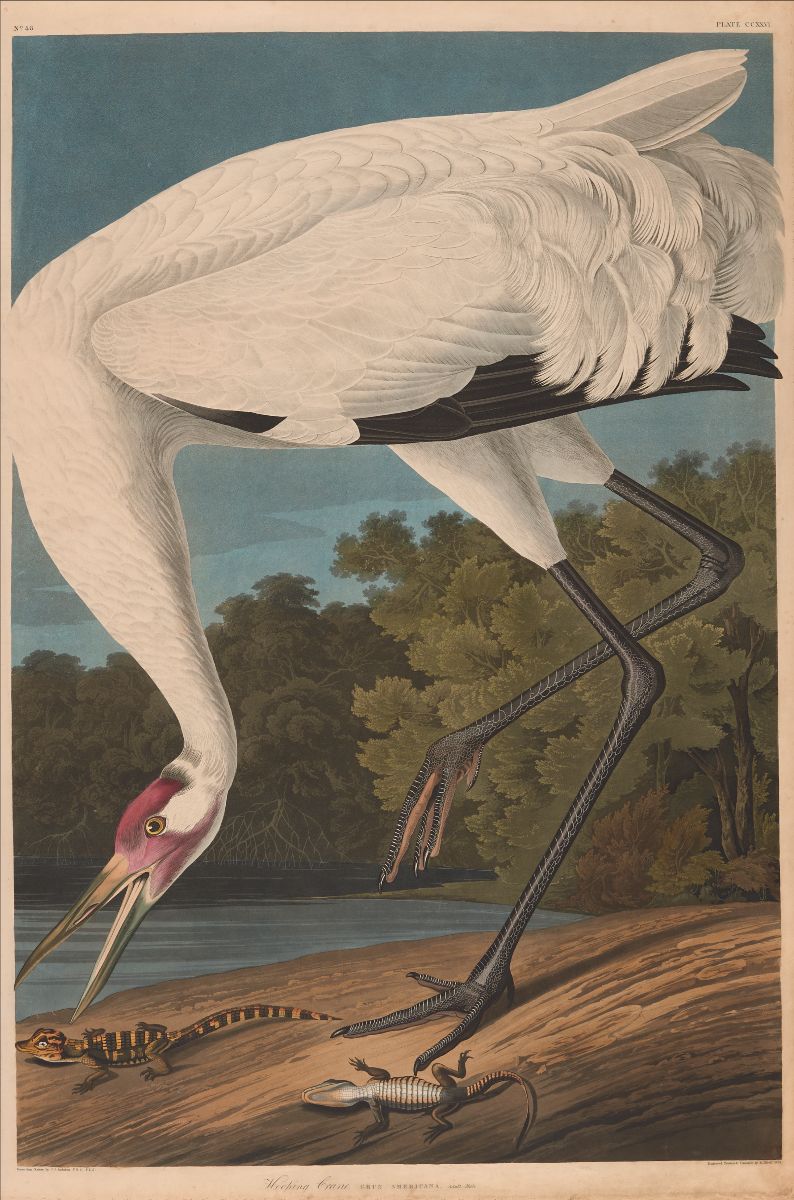
Visit us now through October 12 to see the Hooping Crane (plate 226) on display in the Audubon case in our Main Library reading room. This crane is the tallest bird in North America - which is illustrated in this print! The birds portrayed in the double-elephant folio are drawn to life-size, so the crane is illustrated as bent over in order to fit on the page. And if you look closely, you can see that its tail feathers extend beyond the margins.
Audubon described the crane as, "Proud of its beautiful form, and prouder still of its power of flight, it stalks over the withering grasses with all the majesty of a gallant chief. With long and measured steps he moves along, his head erect, his eye glistening with delight." You can read his full account here.
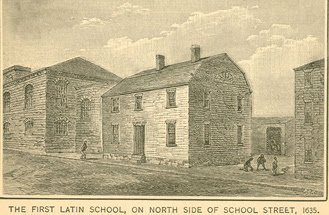 |
| Image courtesy of Boston Latin School |
 |
| Image available in Special Collections |
 |
| The first state-sponsored Normal School, established in 1839 on the Lexington Battle Green. It would later become Framingham State University. |

Before the invention of Braille, Howe developed a raised, embossed type called Boston Line Type, or Boston Line Letter. Examples of this are rare, so we were excited to find pages of line type at the back of our 1833 volume titled Address of the trustees of the New-England Institution for the Education of the Blind to the public.

Education in Massachusetts has come a long way since the start of the Boston Latin School and the work of Horrace Mann. If you’re curious about what is going on with education in Massachusetts these days, check DSpace, our digital repository. Here you’ll find some of the latest documents that the Executive Office of Education has produced, broken down by department or school system. A few collections to note include:
It’s thanks to an exhibit done by State Library staff in 2016 that brought the inspiration for this blog post. Please be sure to take a look at that now-virtual exhibit. It outlines a detailed history of education in Massachusetts and provides some great visuals as well. Happy start of the school year!
Jessica Shrey
Reference Librarian
The September issue of our newsletter is out today! Pictured here is a preview but the full September issue can be accessed by clicking here. And you can also sign up for our mailing list to receive the newsletter straight to your inbox.
