Monday, June 25, 2018

Davy Crockett in Massachusetts

Massachusetts may be just as proud of its folklore as it is about its history. Countless books have been written about legends and lore throughout the commonwealth and its regions, and Massachusetts’ official folk hero is none other than John Chapman, a missionary and gardener from Leominster who many know solely as Johnny Appleseed. But he isn’t the only folk hero to have traversed through New England: in 1834, Davy Crockett made a visit to Boston.

Portrait of David "Davy" Crockett from
An Account of Col. Crockett's Tour to the North and Down East (1835)

David “Davy” Crockett had made a name for himself in East Tennessee for his hunting and storytelling prowess before he was elected to the U.S. House of Representatives in 1827. During his lifetime, he was already the stuff of legend: a satirical play centered around a Crockett parody character named Nimrod Wildfire had opened in 1831, starring popular actor James Hackett in the title role.

This play, as well as an unauthorized biography of Crockett, appropriated his image and reputation and inspired him to create a biography “written by himself.” The memoir was politically driven and not as factual as he claimed, but it led him on a book tour that eventually brought him up to New England. After the book tour, he also wrote an account of the three-week tour itself.


The second publication, An Account of Col. Crockett’s Tour to the North and Down East, was published 1835. After visiting Baltimore, Philadelphia, and New York City, he arrived in Boston.  “I must… tell you where I stopped in Boston – and that was just where anyone that has plenty of cash, and plenty of goodwill for pleasure, would like – in a clean street, with a tavern on one side, and the theatre on the other, and both called Tremont,” he wrote.

Like many tourists that visit Boston today, Crockett saw the sights: “Fanuell Hall,” as he spelled it, where he saw the “accourtrements of war for several companies of infantry and riflemen”; Quincy Market, described as simply, “the market… mayor Quincey’s hammers were keeping time on the big granite stones, and the beautiful pillars were rising up as if he had just ordered them”; the Bunker Hill monument, which was still being built during his visit; the Old State House, where he gave a speech; and the current State House, where there was a statue of George Washington of which he did not approve: “They have a Roman gown on him, and he was an American: this a’n’t right… he belonged to this country-heart, soul, and body: and I don’t want any other to have any part of him – not even his clothes.”

He included an amusing dig at his nemesis Andrew Jackson in his record about the trip: the USS Constitution had a new figure-head in the likeness of Jackson, and when Crockett was asked if it was a good likeness, he responded, “I had never seen him misrepresented; but that they had fixed him just where he had fixed himself, that was – before the Constitution.”

Crockett declined a visit to Harvard University in Cambridge during his trip, comically fearing that “they keep ready made titles or nicknames to give people [there]… I would not go, for I did not know but they might stick an L.L.D. on me before they let me go; and I had no idea of changing ‘Member of the House of Representatives of the United States,’ for what stands for ‘lazy lounging dunce.’” He also visited Roxbury, or “Roxborough,” before heading up to witness the planned industrial city of Lowell, Mass.

“Mill Girls” in the Making-up room, Lawrence Hosiery Co., Lowell, Mass., ca. 1865.
Image courtesy of Historic New England.

Lowell had only been incorporated less than ten years earlier in 1826 and Crockett was absolutely marveled by the brand new manufacturing center. The female workers, Crockett observed, were “all well dressed, lively, and genteel in their appearance; indeed, the girls looked as if they were coming from a quilting frolic.” He toured the factories, speaking to the young girls who worked there, noting that “not one expressed herself as tired of her employment, or oppressed with work: all talked well, and looked healthy.” His accounts of Lowell make the manufacturing center sound like heaven on earth and certainly contain propaganda in favor of the mill-owners that were leading his tour. Only months before his visit, the Lowell mill girls had organized an unsuccessful strike against wage reduction.

Despite these literary works, Crockett was not re-elected in 1835 and famously (or infamously) damned his Tennessee constituents that “they might go to hell, and I would go to Texas.”  He arrived in Nacogdoches as the turmoil of the Texas Revolution began. Later he went to San Antonio, where he famously fought in the Battle of the Alamo and died on March 6, 1836, the last day of the 13-day siege. His death further catapulted him into the annals of American folklore, and today he is one of the most instantly recognized folk heroes in America.

The Fall of the Alamo (1903) by Robert Jenkins Onderdonk.


Further Reading:

An Account of Col. Crockett’s Tour to the North and Down East (1835) available online: https://archive.org/details/accountofcolcroc00crock

Thompson, Bob. “David Crockett, celebrity pioneer, went from wrestling bears to wrestling with his image.” Washington Post, February 8, 2013. <https://www.washingtonpost.com/blogs/liveblog/wp/2013/02/08/david-crockett-celebrity-pioneer-went-from-wrestling-bears-to-wrestling-with-his-image/?noredirect=on&utm_term=.47b58796d44e>


Alexandra Bernson
Reference Staff

Monday, June 18, 2018

Online Guides to Manuscript Collections


In the past couple of years the Special Collections department with the help of our interns, has processed several collections that chronicle the history of Massachusetts and its people. Processing is the intellectual and physical organization of records. After processing is done the processor writes a finding aid (guide) describing the content of the records following archival standards. The finding aid serves as the first point of contact for researchers and it will help them determine if the collection would be of use to their research or if it would contain the information they are seeking.

Detailed listing of the Records of the Ancient
and Honorable Artillery of Massachusetts

Our finding aids are divided into two main categories: legislators’ papers and manuscript collections. You can learn more about these collections by reading their online finding aids, located in our DSpace repository:

Guides to Legislators' Papers: http://archives.lib.state.ma.us/handle/2452/427559
Guides to Manuscript Collections: http://archives.lib.state.ma.us/handle/2452/43872

Have a question?  Contact the library’s Special Collections staff directly via e-mail or by phone:
E-mail: special.collections@state.ma.us
Phone: 617-727-2595

Silvia Mejia
Special Collections Librarian

Monday, June 11, 2018

New Exhibit at the State Library: Massachusetts Firsts

For almost four hundred years, Massachusetts has led the country and the world in many ways. This exhibition celebrates a selection of the inventions, innovations, and events known as “Firsts” in Massachusetts.

This exhibition describes our Commonwealth’s Firsts in a number of categories, including Firsts in Massachusetts, Firsts in the United States, and Firsts in the world. Although the Bay State lays claim to a multitude of historic Firsts, only those that could be verified through a number of reliable sources were included in this exhibition.

The exhibition runs from June 11 through August 31, 2018 and can be viewed outside of the Library, Room 341 of the State House. Library hours are Monday-Friday, 9am-5pm. Can't make it to the library? View the digital exhibit on the library's Flickr site!


Monday, June 4, 2018

June Author Talk: Patricia Harris and David Lyon


Historic New England: A Tour of the Region’s Top 100 National Landmarks
By Patricia Harris and David Lyon
Thursday, June 21, 2018—Noon to 1:00pm
State Library of Massachusetts—Room 341, Massachusetts State House


The State Library invites you to our final author talk of the season: on Thursday, June 21, authors Patricia Harris and David Lyon will speak about their new book, Historic New England: A Tour of the Region’s Top 100 National Landmarks.

Just in time for your summer road trip, this author talk will focus on some of the most interesting historic destinations in all of New England. This region contains one of the highest concentrations of National Historic Landmarks in the country, and although many of these landmarks are historic houses, other New England landmarks are surprisingly quirky, including carousels, submarines, a weather observatory, and a bird sanctuary.

Authors Patricia Harris and David Lyon have traveled and written together for decades and are the authors of more than thirty books about travel, food, and art. They live in Cambridge, Massachusetts, not far from the Longfellow House, and they can be found online at their Hungry Travelers food and travel blog: http://hungrytravelers.com/.

Join us at the State Library at noon on June 21st for a lively discussion of New England’s unique historic landmarks and to get your signed copy of Historic New England.


Laura Schaub
Cataloging Librarian

Monday, May 21, 2018

State Government Open Data

From March 12th to April 30th I completed the Civic Data Ambassadors program, which was offered by the City of Boston in collaboration with the Engagement Lab at Emerson College.  The program was advertised to Boston librarians who were curious about civic data and were interested in becoming Civic Data Ambassadors.  As student ambassadors, we learned about what civic data is, how it can be used to answer questions, how it impacts the Boston community, methods on searching and filtering open data, tools that can be used to create visualizations that can help with analysis, and how to identify when someone else can make use of such data.  “Open data,” as defined by the Open Data Handbook, is data that “can be freely used, re-used and redistributed by anyone;” “use” could mean simply viewing the information for general interest or research purposes, or it could mean using it to create a helpful tool (i.e. weather app, traffic app, etc.).  As part of the course we completed projects using primarily the open data published in Analyze Boston; however, I came out of the program wanting to learn more about open data that is published by the Massachusetts state government.  It’s important to keep in mind that data is just as important and useful for research as published reports are—maybe even more so!  Below are examples of open data portals available online that are maintained by state and quasi-state agencies on a regular basis; they also allow data to be downloaded or exported into user-friendly formats (i.e. CSV and Excel files).

Dataset titled “Lead and Copper Drinking Water Results in Schools/Childcare,”
published via the Office of Energy and Environmental Affairs Data Portal.


General
MassData: the Open Data Initiative for the Commonwealth of Massachusetts

Education
Massachusetts Department of Higher Education Data Center
MA Department of Elementary and Secondary Education (DESE) School & District Statewide Reports

Transportation
Massachusetts Department of Transportation (MassDOT) Open Data Portal
Massachusetts Bay Transportation Authority (MBTA) Data Dashboard

Financial/Economic
Office of the Comptroller’s CTHRU:  Financial Records Transparency Platform
Massachusetts Water Resources Authority Open Checkbook
Division of Banks Foreclosure Petition Website
Massachusetts Office of Campaign and Political Finance Contributions and Expenditures Data
Department of Unemployment Assistance - Labor Market Information (LMI)

Energy and Environment
Office of Energy and Environmental Affairs (EEA) Data Portal
Mass Save Data

Health
Center for Health Information and Analysis (CHIA) Databooks
Massachusetts Environmental Public Health Tracking

Municipal
Division of Local Services (DLS) Municipal Databank
Metropolitan Area Planning Council (MAPC) Open Data

If you are interested in Geographic Information System (GIS) mapping, check out our earlier blog about shapefiles, data layers, and mapping tools published by the state: http://mastatelibrary.blogspot.com/2016/12/massachusetts-interactive-mapping.html 


Kaitlin Connolly
Reference Department


Monday, May 14, 2018

The War against the Gypsy Moth in Massachusetts

If you aren’t an entomologist, there are probably few insect varieties that you know by species name. But most, if not all, citizens of Massachusetts and her surrounding states know the gypsy moth. Known by the Latin name Lymantria dispar, this particular moth has been devastating woodlands and forests in Massachusetts for over a century.

Image provided by the Department of Conservation and Recreation

The moth was accidentally introduced to Massachusetts in 1869, when a French-born amateur entomologist named Étienne Léopold Trouvelot imported the insect, probably via egg masses, to his home in Medford, Mass. He was occupied with experiments involving silk worms and he hypothesized that breeding silk worms with the robust gypsy moth found in Europe would allow the resultant cross breed to better survive handling and relocation as well as have a more varied diet and avoid existing natural predators, all of which made it ideal for commercial production of silk.

At the time, entomology was still a growing and disorganized science and the importation of insect species was not considered as potentially harmful or invasive. These “men of science were slow to understand the adverse consequences, and government authorities were ambivalent about regulating the practice… there were no legal, moral, or ethical restraints against the practice of transporting alien insects anywhere” Robert J. Spear wrote in his book The Great Gypsy Moth War (2005). Further, Trouvelot’s friend remembered that the backyard enclosure that he used to breed moths was enclosed by netting with significant holes, often large enough for native birds to get in and eat the experimental larvae. Despite these recollections, today we have no evidence of how the first eggs, larvae, caterpillars or adult gypsy moths escaped the enclosure.

Photograph of Trouvelot’s home in Medford, from
Ravages of the Gypsy and Brown Tail Moths 1905 (1906)

Trouvelot eventually turned his attention to other projects and experiments and the moth did not appear to trouble many people for several decades. Later in the 1890’s some witnesses and neighbors remembered Trouvelot searching for the insects, even destroying egg clusters and notifying local authorities of the insect’s escape. However, there is no evidence of these warnings, and by the time the gypsy moth became a problem in the 1890s, Trouvelot had long since moved back to France.

In 1889, swarms of gypsy moths invaded Medford. “Citizens could only stare in disbelief as the dirt streets became carpeted with millions of larvae that seemed to have materialized out of the earth… Great pulsating masses of larvae stripped any plant along their path in minutes,” (Spear). The train rails running through Medford were stained green by crushed larvae, and as they swarmed homes the sound of the larvae eating any and all vegetable matter both inside and outside homes was audible (Spear). The town roads commission attempted to battle the insects, but eventually the fear that the insect would attack agricultural communities inspired ambitious entomologists to urge Medford selectmen to petition the Legislature for assistance.

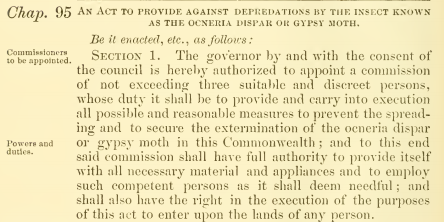
The outbreak had inspired the organization of the American Association of Official Economic Entomologists, later simply the Association of Economic Entomologists. Economic Entomologists believed that the insect had to be fully exterminated, rather than suppressed and controlled, to protect agricultural interests and with their urging the State Legislature passed an act that more or less declared war on the invasive species in 1890.

Section 1 of Chapter 95 of the Acts and Resolve of 1890,
which created the Gypsy Moth Commission

The Commission, under the Board of Agriculture, organized an army to exterminate the insect. By then the gypsy moth was spreading, found in the surrounding towns of Malden, Melrose, Stoneham, and more. The bulk of the army was made up of “privates” who were trained to spray Paris green, an arsenic-based insecticide. Spraying was expensive, and other crews instead scrapped egg masses away, wrapped trees with burlap to stop caterpillars from climbing to the foliage, or burned trees and brush altogether to kill off potential feeding grounds. Only after years of using arsenic-based insecticide would entomologists discover that gypsy moths are impervious to this particular chemical and that spraying arsenic had actually damaged native populations of birds and insects that might have fed on the gypsy moth.

The Gypsy Moth Commission was dependent on yearly appropriations from the Legislature, which made it difficult to hold on to trained personnel when funds ran out for a particular year. They also encountered resistance from private citizens who disapproved of the Commission’s employees coming onto their land without their permission, and much of the testimony provided in hearings regarding the gypsy moth war was given from these individuals. When the infestation threatened Middlesex Fells, the new Metropolitan Park Commission also stood in opposition to any destruction of public woodlands.

A page of testimony from the 1896 hearings

Despite years of work and reports swearing that the Commission was curbing the infestation, the moth continued to gain ground through Massachusetts to the utter bafflement of the economic entomologists involved in the Gypsy Moth Commission. They began to doubt that extermination was even possible. By 1900, an investigative committee began looking into the Gypsy Moth Commission and hearings were held to question those involved. The resultant report found that the efforts were misdirected and the expenditure of state funds had been “extravagant” due to mismanagement. The Commission did not remain for much longer.

The gypsy moth infestation continued to spread and by 1922 they were found in every single town and city in Massachusetts. The federal government eventually got involved as the infestation crossed state lines, and with the invention of DDT (a synthetic chemical compound) in 1946 aerial spraying began on infested areas. However, that didn’t stop the infestation of 1981, which is believed to be “the nadir of the struggle against the gypsy moth, a time when the insect seemed unstoppable and when its voracious habits results in the ‘defoliation’ of thirteen million acres--the greatest damage to trees ever caused by a single insect species in the United States” (Spear). Today, the state’s management has shifted from spraying to relying on nature to manage gypsy moth populations, including a fungus known as Entomophaga maimaiga that spreads quickly and causes significant gypsy moth mortality (Gypsy Moth in Massachusetts). Even so, the insect continues to be an issue both in the state of Massachusetts and throughout the United States.

Further reading:


Alexandra Bernson
Reference Staff

Monday, April 30, 2018

Library of Congress Magazine: A Plethora of Information

The State Library is a selective Federal documents depository library. One publication from the Library of Congress is called Library of Congress Magazine. This publication focuses on the collections and projects in the Library of Congress and frequently covers topics of a historical nature.  In the November/December 2017 issue one topic covered is “The Hamilton Papers: A Founding Father Online.”  The Library placed thousands of Hamilton’s letters online for the first time including one he wrote in 1769 as a 12 or 13 year old clerk in St Croix that covered topics such as excise taxes and how to avoid them, and his ambition to raise himself up to a higher station in life.  The Library goes on to say that “The Library holds the world’s largest collection of Hamilton papers, some 12,000 items concentrated from 1777 to Hamilton’s death by duel in 1804.” The letters include correspondence with well- known men such as George Washington, John Adams, Thomas Jefferson, James Madison and John Jay.  After Hamilton died his wife Elizabeth Schulyer Hamilton held onto her husband’s papers. She tried to get the US government to buy them and she succeeded in 1848 when Congress appropriated $20,000 to buy the papers.


This issue also has a story of “Veterans on the Homefront.”  This article includes a profile of Violet Clara Thurn Cowden of South Dakota who was a Women Airforce Service Pilots (WASP).  She served her country by being employed as a pilot to fly domestically in order to liberate men for service overseas.  She was underweight and under the height requirement so she gorged on bananas and put a wrap in her hair to pass the physical examination.  She thought joining the WASPS would allow her to “do the thing I love most, and I didn’t have to pay for the gas.”

In another article called “An App for Them,” two sisters have created a user-friendly tool that allows veterans to record their stories of their service using just their smartphones.  It was developed for the Veterans History Project, which the U.S. Congress created in October 2000.  The app was started by two sisters in Massachusetts Jean Rhodes and Nancy McNamara.  It started when Rhodes first encountered the Veterans History Project.  She was conducting interviews with veterans alongside her son and found the process cumbersome.  She called her sister who owns her own web design company for advice.  They built a pilot app and tested it out and hired a firm to develop the app. Their product which they are donating to the Library has been tested by folklorists, oral historians from universities, the Smithsonian National Museum of the American Indian, Rep. Joseph Kennedy III (D-Mass.) and Sen. John Boozman (R-Ark.), who have both used the app to interview veterans in their home states.


Naomi Allen
Reference Librarian