Monday, February 21, 2022

Researching Federal Legislation

If you’ve ever researched Massachusetts legislation, you might be familiar with how difficult it can be. Even if a researcher has compiled all the necessary primary and secondary materials to review, intent can still be difficult or impossible to infer—it’s the “white whale,” so to speak. However, if you’re new to researching federal legislation, you might be pleasantly surprised at how many explanatory materials are produced during the lawmaking process. In fact, it’s even common to find pre-compiled federal legislative histories, whereas in Massachusetts the compiling must be completed by the researcher. There are also many examples of “similar but different” or even “very different” when comparing Massachusetts and federal research. For example, certain terminologies can mean very different things, such as “committee report”:

  • Massachusetts definition: The report is not a written document but the recommendation of a Committee that a bill ought to pass (OTP), ought not to pass (ONTP), or ought to pass with an amendment (OTPWA). (source)
  • Federal definition: Document accompanying a measure reported from a committee. It contains an explanation of the provisions of the measure, arguments for its approval, votes held in markup, individual committee members’ opinions, cost estimates, and other information. (source)

As this blog aims to highlight federal legislative research, here are some helpful resources and guides that will help you learn about: the federal legislative process; how to locate primary documents, compiled histories (if available), and secondary materials; and other important information:

Federal government resources:

Non-government resources:

Subscription databases:
(most commonly found in law, academic, and government libraries)

  • ProQuest Congressional
  • ProQuest Legislative Insight
  • HeinOnline


Kaitlin Connolly
Reference Librarian


Monday, February 14, 2022

Happy Library Lovers Day!


February 14th is Library Lovers Day, and the Massachusetts Board of Library Commissioners (MBLC) has a website where Massachusetts residents can show their love for libraries by writing a valentine to their local library. If you want to participate and show your local library your support, upload your valentine today through this site: https://www.lovemasslibraries.com/.


Silvia Mejia
Special Collections Department 

Monday, February 7, 2022

Virtual Author Talk: Jerald Walker

Register Online

Join us on February 28th for an online conversation with Dr. Jerald Walker, author of How to Make a Slave and Other Essays, which was a National Book Award Finalist and the winner of the 2020 Massachusetts Book Award for Nonfiction. This online event is presented in partnership with the libraries of Ashland, Brookline, Newton, Tewksbury, and Watertown, and is free and open to all.

About the book:
For the Black community, Jerald Walker asserts in How to Make a Slave, “anger is often a prelude to a joke, as there is broad understanding that the triumph over this destructive emotion lay in finding its punchline.” It is on the knife’s edge between fury and farce that the essays in this exquisite collection balance. Whether confronting the medical profession’s racial biases, considering the complicated legacy of Michael Jackson, paying homage to his writing mentor James Alan McPherson, or attempting to break free of personal and societal stereotypes, Walker elegantly blends personal revelation and cultural critique. The result is a bracing and often humorous examination by one of America’s most acclaimed essayists of what it is to grow, parent, write, and exist as a Black American male. Walker refuses to lull his readers; instead, his missives urge them to do better as they consider, through his eyes, how to be a good citizen, how to be a good father, how to live, and how to love.

About the author:
Dr. Jerald Walker is the author of The World in Flames: A Black Boyhood in a White Supremacist Doomsday Cult and Street Shadows: A Memoir of Race, Rebellion, and Redemption, winner of the 2011 PEN New England Award for Nonfiction. He has published in magazines such as Creative Nonfiction, Harvard Review, Mother Jones, and Oxford American, and he has been widely anthologized, including five times in The Best American Essays series. The recipient of James A. Michener and National Endowment for the Arts fellowships, Walker is Professor of Creative Writing at Emerson College.

To register for this free online event, please visit: https://us06web.zoom.us/webinar/register/2016414241464/WN_dhtmMjXcSiuBxggIXhauRA


Author Talks Committee
State Library of Massachusetts


Thursday, February 3, 2022

Friends of the Library Newsletter – February issue

Did you know that February is Library Lovers Month? Celebrate with the latest issue of the Friends newsletter! Pictured here is a preview of our February newsletter, to access the full version click here.

If you would like to receive the newsletter straight to your inbox, you can sign up for our mailing list here. And if you would like to join the Friends, find more information on our website.


Wednesday, February 2, 2022

Happy Groundhog Day!

February 2 is well-known in the United States, and especially in our Commonwealth of Massachusetts, as Groundhog Day. We are proud to honor today Ms. G, the Massachusetts State Groundhog. Ms. G is a female groundhog living at Mass Audubon Drumlin Farm Wildlife Sanctuary in Lincoln, Massachusetts. She has been forecasting the weather on Groundhog Day since 2008.  

The story of Ms. G’s official designation as the Massachusetts State Groundhog is well-documented in several places, including her own website and in a beautifully-written book by meteorologist Mish Michaels called Ms. G's Shadowy Road to Fame. The illustrations by Kathleen Jameson bring the story to life. After hard work by students at Hunnewell Elementary School in Wellesley, and with help from State Representative Alice Peisch and other dedicated fans of Ms. G, Governor Deval Patrick signed the bill into law on July 31st, 2014.

In our 2017 exhibition on state symbols of Massachusetts, we used a stuffed animal purchased from Mass Audubon Drumlin Farm to illustrate Ms. G’s status as the State Groundhog. A photograph of the real Ms. G is here. Please join us in wishing her a long and healthy life!


Beth Carroll-Horrocks
Special Collections

Monday, January 31, 2022

On (Virtual) Display in the State Library

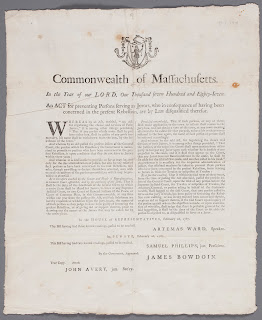
This month, our featured collection item is a broadside dating to February 1787 and issued by the Massachusetts General Court while James Bowdoin was governor. Titled in part as “An Act for Preventing Persons Serving as Jurors, Who in Consequence of Having Been Concerned in the Present Rebellion, Are by Law Disqualified Therefor,” the broadside addresses some consequences for those who participated in Shays’ Rebellion, which concluded earlier in the month that this Act was passed. 

James Bowdoin was elected as governor in May 1785, following John Hancock’s resignation partway through his term. Once in office, Bowdoin worked to collect back taxes, which Hancock had been reluctant to actively pursue while governor. But in a depressed post-Revolutionary War economy, Bowdoin made it a priority to both raise taxes and collect back taxes in an effort to raise funds for the state’s portion of foreign debt payments to European war investors. This was met by protest from those in the central and western parts of the state who were struggling financially since they had not been paid for their wartime service. Individuals now found themselves having to pay high taxes that they could not afford, or risk losing their livelihood, a situation that caused unrest and ultimately led to what we now know of as Shays’ Rebellion. 

This month marks 235 years since the conclusion of Shays’ Rebellion, which was an armed uprising that occurred in western Massachusetts beginning in the summer of 1786. Residents of the area organized protests in response to the fact that the legislature had adjourned without addressing their concerns about taxation. From August to October, groups of protesters successfully forced the closure of courts in Northampton, Worcester, Great Barrington, Concord, and Taunton. In January 1787, led in part by Daniel Shays, groups of protesters organized in an attempt to overtake an armory in Springfield. They were met by a militia organized by Gov. Bowdoin, which consisted primarily of individuals from the eastern part of the state. Clashes continued from the end of January into early February, before the protesters’ forces fell apart and many participants fled north.

The broadside in our collection was Issued by the General Court in the weeks after Shays’ Rebellion. The Act printed on it stated that anyone who favored the rebellion, or gave aid or support to the rebellion, was prohibited from serving as a juror for three years. Selectmen from the towns in which the participants resided were instructed to remove their names from the jury-boxes (from which names would be drawn to serve as jurors). Earlier in February, the legislature also passed the Disqualification Act, which disqualified any known participant in the rebellion to serve in some elected or appointed positions. There is a lot more to the economic climate leading to Shays’ Rebellion, the rebellion itself, and its aftermath than we can address in this blog post. To learn more, check your local library for books like  Shays's Rebellion: Authority and Distress in Post-Revolutionary America by Sean Condon and Shay’s Rebellion: The American Revolution's Final Battle by Leonard L. Richards.

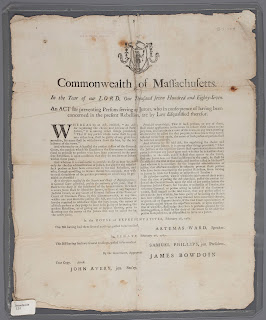
And lastly, a note on the condition of this broadside, since it looks pretty good for having been printed 235 years ago! We do a lot of collection repair and preservation work in-house, but we send items out to the Northeast Document Conservation Center (NEDCC) for more involved work. In 2018, this broadside was one of a few that underwent treatment at NEDCC. It was removed from its plastic enclosure and then cleaned to reduce staining, discoloration, and acidity. It was also humidified so the edges could be uncurled and creases reduced, and then any tears and losses were mended with thin Japanese paper and wheat starch. Check out the image to the right to see how it looked before treatment and compare that with the “after” photo featured at the beginning of this post! 

Elizabeth Roscio
Preservation Librarian


Monday, January 24, 2022

19th and Early 20th Century Massachusetts Campaign Literature

The State Library has a wonderful collection of historical literature from various 19th and early 20th century Massachusetts political campaigns. It’s interesting to see how early campaigns were run, the issues that were addressed, and what slogans were used. Here are some examples from our collections:

Full versions of some of the pamphlets shown above are available in the library’s DSpace repository:

You can also search our online catalog for additional early campaign literature and other political publications.


Kaitlin Connolly
Reference Librarian